

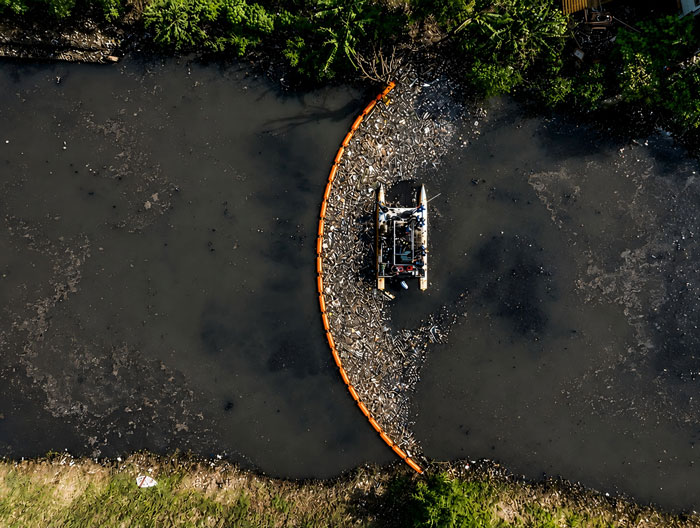
Floating trash and debris can quickly accumulate around rivers, ports, marinas, water intakes and other waterfront facilities. Plastic bottles, packaging, branches, vegetation and larger floating objects may not only affect the appearance of the waterway but can also interfere with vessels, drainage systems and waterfront operations.
A floating trash boom provides a practical way to intercept and concentrate this material before it spreads further downstream or reaches a more difficult cleanup area.
However, not every trash boom should be designed in the same way. A lightweight barrier installed in a sheltered marina faces very different forces from a heavy-duty debris boom installed across a fast-flowing river.
Before requesting a quotation, buyers should consider five important factors.
If you are still evaluating whether a floating barrier is suitable for your project, you can first read What Are the Benefits of Using Floating Trash Booms?. The article explains some of the environmental and operational reasons for using floating trash barriers.
The first question is not simply how many metres of boom are required. It is what the boom will actually need to stop.
Small floating plastics, bottles, cups, leaves and light vegetation create a very different load from large branches, timber or heavy storm debris. The size, weight and quantity of the material influence the required flotation, freeboard, tensile strength and overall boom construction.
For relatively light floating litter in a calm marina or lake, a simpler floating barrier may be sufficient. When larger natural debris or timber is expected, a more robust design with stronger structural components may be required. JXY's Trash & Debris Boom range includes designs intended for different environments, from lakes and ports to coastline and offshore conditions.
The installation environment is just as important as the debris itself.
A trash boom used inside a sheltered marina may experience relatively low current and small waves. A river installation may be exposed to continuous flow, seasonal rainfall and changing water levels. A port may have waves, vessel movement and larger floating objects, while coastline applications can experience tides and more dynamic water conditions.
These differences affect the type of boom that should be selected.
For example, JXY offers floating trash boom designs for sheltered lakes as well as heavier-duty port, coastline and offshore conditions. The correct choice depends on the actual operating environment rather than simply selecting the largest available boom.
For projects involving flowing rivers and significant plastic pollution, you can also read How River Trash Booms Solve Plastic Pollution in LATAM Cities. That article looks more specifically at trash containment in moving water and the importance of reducing unnecessary hydraulic resistance.
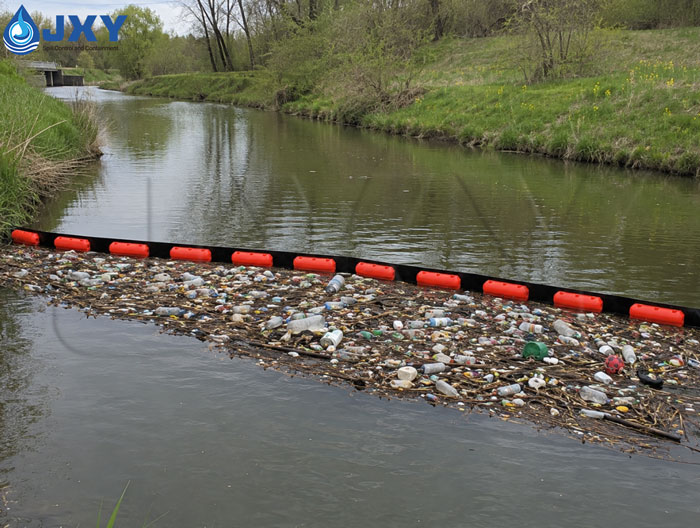
Buyers sometimes focus mainly on the visible height of the boom, but the forces acting on the complete barrier can be more important.
As floating debris accumulates against the boom, the load on the barrier and anchoring system increases. Moving water can add further pressure, particularly when the barrier includes a deep or impermeable underwater skirt.
This is one reason why a boom designed for calm water should not automatically be used in a fast river.
In higher-flow applications, a flow-through design using suitable mesh or netting may allow more water to pass through while still intercepting bottles, plastics, vegetation and other floating debris. In other situations, an impermeable skirt may be preferred when smaller floating material needs to be contained.
The most appropriate configuration therefore depends on the combination of water movement, debris size and expected debris accumulation, rather than any one factor alone. JXY's existing river solution uses flow-through concepts for dynamic water environments, while several of its other debris-boom models use impermeable PVC skirts for different conditions.
Even a well-designed trash boom will not perform properly if the installation layout is unsuitable.
Before ordering, it is helpful to consider where the boom will be fixed, the approximate water depth, the width of the waterway and the direction of the current. Buyers should also think about where the collected debris is expected to accumulate and how workers or equipment will remove it.
In many projects, installing a boom directly at 90 degrees across a strong current may create unnecessary loading. A different installation angle can help guide floating debris toward a designated collection point and make routine removal easier.
Anchoring requirements also vary considerably between a sheltered marina and a river affected by strong flow or seasonal flooding. The boom, tension system and anchoring arrangement should therefore be considered as one system.
This information is especially useful to provide when requesting a customized quotation.
Installing the trash boom is only part of the solution. The collected material still needs to be removed.
If floating trash is allowed to accumulate for too long, the load on the boom and its anchoring system will continue to increase. A successful installation should therefore include a practical collection and maintenance plan.
For a marina, workers may be able to collect debris manually from the dock. For a river or canal, the boom may be positioned to guide debris toward an accessible bank. Larger projects may require workboats, cranes, mechanical grabs or other collection equipment.
The best trash boom layout is therefore not simply the one that catches the most debris. It should also make the debris easy to reach, remove and dispose of.
This is especially important for long-term installations where trash accumulation is continuous.
There is no single trash boom specification suitable for every site.
A sheltered marina collecting light plastic waste may require a relatively simple system, while a fast-flowing river carrying vegetation and timber may require greater strength, different flotation and a completely different anchoring arrangement.
JXY manufactures floating trash and debris barriers for a variety of water conditions and can customize dimensions, flotation, skirt or mesh configuration, connectors and other components according to the application.
You can view the available designs here: JXY Trash & Debris Boom Product Range
The current product range includes barriers for lakes, heavy-duty port conditions, rivers, coastlines and offshore applications.
| Information Required | Example |
| Project Location | River, port, marina, canal or lake |
| Required Boom Length | 100 m, 300 m, 500 m |
| Main Debris Type | Plastic, vegetation, branches, timber |
| Water Conditions | Calm, flowing river, tidal or exposed |
| Approximate Current Speed | If available |
| Water Depth | Approximate depth at installation area |
| Installation Layout | Site drawing or photo if available |
| Deployment Period | Temporary or permanent |
| Delivery Destination | Port / city / country |
Even if all of this information is not yet available, photographs, drawings or a short description of the project can help JXY understand the site conditions and recommend a more appropriate trash boom configuration.
If you are planning a floating debris control system for a river, port, marina, canal or other waterway, send JXY your project location, required barrier length, main debris type and available water-condition information.
Our team can recommend a suitable floating trash boom design and prepare a quotation according to the actual application.


