

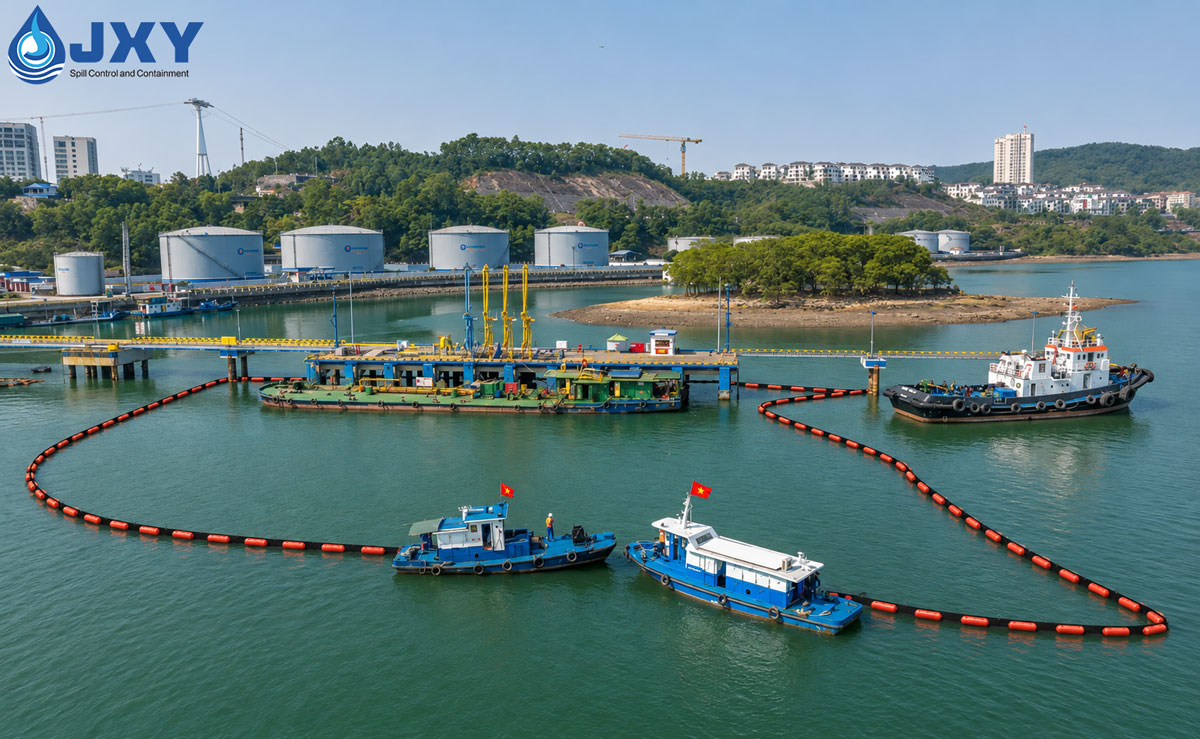
A small oil spill can become a major operational problem when it happens in the wrong place.
For a port, floating oil near an active berth may delay vessel operations. For a marine terminal, an accidental release can spread beyond the facility's working area. For a power plant or desalination facility, oil approaching a seawater intake may threaten an essential part of daily operations.
In these environments, the real challenge is not always the size of the spill. It is how quickly contamination can reach sensitive infrastructure—and whether the facility is prepared to control it.
This is why permanent oil containment booms are an important consideration for marine facilities with ongoing exposure to surface oil pollution.
A permanent oil boom provides a pre-positioned barrier that can help contain or redirect floating oil before it spreads into critical areas. However, the value of such a system depends on much more than simply leaving a boom in the water.
For facility managers, the objective is to establish a practical, long-term protection strategy that fits the site's environmental conditions, operational activities, and response capabilities.
Many marine facilities already maintain emergency spill response procedures. They may have portable booms, absorbent materials, recovery equipment, and trained personnel available when an incident occurs.
These resources are essential, but they do not always address the first moments of an unexpected spill.
Consider an incident at a fuel transfer berth. Even when response teams act promptly, floating oil may begin moving with wind and surface currents before temporary containment equipment is fully deployed.
The same challenge applies to facilities located near busy shipping channels or industrial waterfronts where a spill may originate outside the operator's property.
For these facilities, pollution risk is not limited to their own equipment or activities.
A permanent oil boom can provide a continuously available protective measure in areas where oil exposure is predictable.
It does not replace prevention procedures or emergency response plans. Instead, it adds another layer of preparedness between a potential spill and the infrastructure that needs protection.
The main benefit is not simply faster containment. It is reducing dependence on emergency deployment as the first line of protection.
Permanent oil booms are especially relevant where surface oil contamination could affect essential operations, sensitive resources, or valuable marine infrastructure.
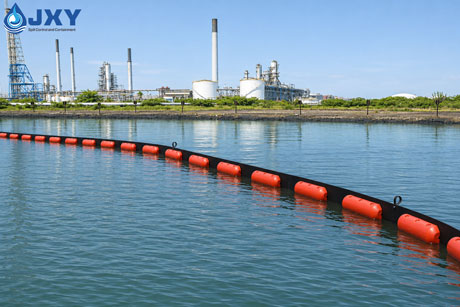 Ports and Commercial Harbors
Ports accommodate vessel traffic, bunkering, cargo handling, and maintenance activities, often within relatively confined waters.
If floating oil reaches an active berth, the consequences can extend beyond cleanup. Operators may need to restrict work areas, coordinate vessel movements, and manage environmental reporting requirements.
A permanent boom may help protect selected port boundaries, sensitive waterfront sections, or designated containment areas.
However, the installation must remain compatible with vessel access and safe navigation.
For a busy harbor, the appropriate solution may involve protecting specific high-risk locations rather than enclosing an entire operational basin.
Oil terminals and bunkering facilities face particular risks during fuel transfer and marine loading activities.
Even a localized release can spread along a quay or toward nearby vessels if water conditions allow.
A well-planned boom arrangement can help keep floating oil within an accessible response area or guide it toward a designated recovery point.
The ability to recover collected oil is just as important as the barrier itself.
A boom that concentrates oil in a location where recovery equipment cannot operate safely may create additional problems.
Power stations, cooling facilities, desalination plants, and other industrial operations may depend on a reliable supply of seawater or river water.
Oil contamination near an intake can require additional monitoring, operational adjustments, or temporary protective measures.
A permanent boom may help reduce the movement of floating oil toward the intake, particularly where the site permits an effective exclusion or diversion arrangement.
However, conventional oil booms primarily control floating oil. They cannot guarantee protection against dissolved hydrocarbons or oil droplets carried below the surface.
For this reason, water intake protection should combine physical barriers with appropriate monitoring and operational response procedures.
Shipyards and marine maintenance facilities may experience pollution risks associated with vessel repairs, fueling, equipment operation, and nearby industrial activities.
Permanent booms can support pollution control at selected locations where continuous surface protection is needed.
The right solution depends on the site's activities, water conditions, and the potential impact on neighboring facilities.
Temporary oil booms and permanent oil booms serve different operational needs.
Temporary systems are valuable when response teams must move equipment between locations or deploy containment around an unexpected incident.
Permanent systems are more relevant when the same infrastructure requires protection over an extended period.
For example, a marine terminal may need emergency booms for vessel incidents while maintaining a permanent barrier near a sensitive discharge or intake area.
A waterfront facility with occasional spill exposure may find temporary equipment more practical than a fixed installation.
The decision should therefore reflect the actual risk rather than an assumption that permanent equipment is always better.
Facility operators should consider how frequently oil exposure is possible, how quickly temporary equipment can be deployed, and whether a fixed barrier would interfere with daily operations.
Where both approaches are necessary, they can complement each other.
For a closer comparison of different boom types, read JXY's Fence Boom vs. Solid Float Boom: Which Oil Containment Solution Is Right for You?.
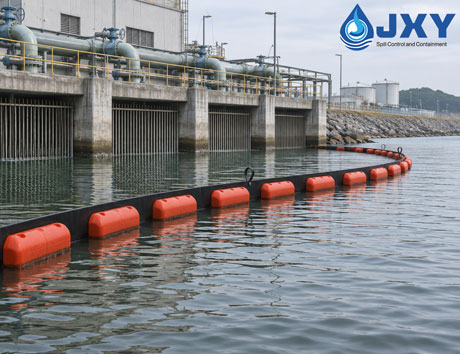 What Should a Permanent Oil Boom Actually Protect?
One of the most common purchasing mistakes is focusing on boom length before identifying the protection objective.
A customer may initially request several hundred meters of permanent boom without a clear deployment plan.
However, measuring the waterfront alone does not determine the most effective protection arrangement.
The first question should be:
There are three common objectives.
For some terminal operations, the priority is to limit the spread of oil from a known risk area.
A boom arrangement may help hold floating oil within a manageable zone until recovery equipment can be deployed.
This approach is more practical when the area is accessible and water conditions support effective containment.
For water intakes or protected waterfront facilities, the objective may be to keep floating oil away from critical infrastructure.
The location of the barrier should reflect the direction from which contamination is likely to approach.
For example, a facility exposed to passing marine traffic may need protection on the side facing the main pollution risk rather than an arbitrary enclosure.
In moving water, attempting to stop floating oil directly across the current may be ineffective.
An angled boom arrangement may help guide oil toward a safer and more accessible collection point.
Such a solution must be assessed carefully to avoid redirecting pollution toward other sensitive areas.
The most suitable protection strategy is defined by oil movement, facility operations, and recovery access, not simply by the size of the boom.
Marine conditions play a major role in the performance of any permanently deployed oil boom.
A sheltered harbor, a tidal river entrance, and an exposed coastal terminal can present very different operating conditions.
For example, a boom may remain securely anchored while strong currents carry some floating oil beneath it.
In another location, wave action may allow oil to pass over the barrier. Tidal changes can also affect the boom's position and the direction of approaching contamination.
This is why a boom's structural durability should not be confused with its actual oil containment performance.
Before selecting a permanent system, facility operators should understand the site's normal and more demanding environmental conditions.
Important considerations include current speed and direction, tidal range, wave exposure, water depth, seasonal weather, and the possibility of floating debris.
Where currents are significant, the deployment layout may need to be adjusted to reduce the force of water acting directly against the boom.
For an exposed location, a combination of alternative placement, additional protective measures, or a different response strategy may be required.
There is no universal boom arrangement suitable for every water condition.
A reliable solution begins with realistic expectations about what the barrier can and cannot achieve.
A permanent oil boom is a long-term operational commitment. Before proceeding with a purchase, facility managers should answer five questions.
1. Where Is the Greatest Exposure to Floating Oil?
Identify nearby fuel handling activities, shipping traffic, industrial operations, and possible spill pathways.
Understanding the likely source and direction of contamination helps determine which areas need priority protection.
2. Will the Installation Interfere with Normal Operations?
A barrier must not create unacceptable hazards for vessels, maintenance teams, or emergency access.
At active terminals, operational compatibility can be just as important as containment effectiveness.
3. What Happens When Oil Accumulates?
A boom does not remove oil from the water.
Facilities need a practical plan for collecting and disposing of accumulated contamination, including suitable equipment and safe access.
4. What Conditions Must the System Withstand?
The expected deployment environment determines whether long-term installation is practical and what performance limitations should be considered.
Seasonal conditions should not be overlooked simply because the site appears calm during a survey.
5. Who Will Inspect and Maintain the Boom?
Permanent equipment requires regular attention.
Responsibility for inspections, debris removal, repairs, and replacement should be established before the system is installed.
These questions can help buyers move from a general product inquiry toward a more effective project specification.
A permanent oil boom should not be treated as maintenance-free equipment.
Continuous exposure to sunlight, saltwater, marine growth, debris, and changing water levels can gradually affect the system.
For facility operators, reliable protection depends on how consistently the boom is inspected and maintained.
Routine checks should look for visible damage, abnormal positioning, excessive debris accumulation, worn components, and other changes that could affect performance.
Additional inspections may be necessary after storms, unusual currents, or incidents involving vessels and floating debris.
Marine growth and accumulated waste can also increase maintenance requirements, particularly in sheltered industrial waters.
An effective maintenance plan should include inspection responsibilities, reporting procedures, corrective actions, and records of completed work.
It is also sensible to plan for repair access and the eventual replacement of worn equipment.
A system that is difficult to inspect or maintain may create higher operational costs over time.
For related maintenance considerations, see JXY's How to Extend the Service Life of Your PVC Oil Booms.
The goal is not simply to achieve the longest possible service life. It is to keep the protection system dependable throughout its intended operating period.
When comparing quotations, the lowest initial equipment price is not necessarily the lowest long-term cost.
A facility should consider the complete protection arrangement, including installation, maintenance, inspection access, and eventual replacement.
For example, a lower-priced solution that requires frequent repairs or creates operational difficulties may become more expensive over time.
On the other hand, a heavier system is not automatically better if the site does not require it.
The most practical investment is one that matches the facility's actual exposure and operating conditions.
Buyers should also clarify the scope of a supplier's quotation.
Does it include only the floating boom? Are installation accessories included? Who is responsible for the anchoring design and site installation? Are replacement components available?
These details can significantly affect project budgeting and delivery expectations.
For procurement teams, evaluating the complete scope of supply is more useful than comparing prices per meter alone.
Customers do not need a complete engineering design before contacting a manufacturer.
However, providing clear project information can make the initial discussion much more productive.
Useful details include:
Facility type: Port, terminal, jetty, water intake, industrial plant, or another marine location.
Project location: Country, port, river, or coastal site.
Protection objective: Containment, exclusion, or diversion of floating oil.
Approximate required distance: Estimated length or basic dimensions of the protected area.
Environmental conditions: Available information about currents, tides, waves, and water depth.
Deployment duration: Continuous installation or a specified operating period.
Site limitations: Vessel traffic, anchoring possibilities, maintenance access, and recovery arrangements.
A site drawing, waterfront photograph, or simple aerial sketch is often helpful.
With this information, a manufacturer can begin reviewing appropriate equipment options and identify any additional technical information required.
For buyers considering a long-term installation, JXY offers a Permanent Heavy Duty Oil Boom range that can serve as a starting point for project discussions.
Final equipment selection should always reflect the actual application and site conditions.
Permanent oil containment booms can play a valuable role in protecting marine facilities, but their effectiveness depends on how well they address the real operating environment.
For a port, the priority may be limiting the consequences of an accidental fuel release without disrupting vessel activities.
For an industrial water intake, the objective may be reducing exposure to floating oil approaching essential infrastructure.
For a terminal or shipyard, the focus may be maintaining an accessible containment area as part of ongoing environmental preparedness.
These are different problems, and they should not automatically lead to the same equipment recommendation.
With manufacturing experience in oil spill response products dating back to 2004, JXY works with international buyers seeking equipment for marine and industrial applications.
We believe that effective equipment selection begins with understanding the customer's site and protection objectives.
Whether you are planning a new facility, reviewing an existing spill response system, or considering equipment replacement, our team can discuss suitable oil containment boom options based on your project requirements.
Tell us where the boom will be deployed, what you need to protect, and what water conditions you expect.
Send your site drawing, approximate protection distance, and application details to JXY for an initial technical discussion and quotation.
Our team can help you review suitable product options and clarify the information needed before making a purchase decision.


