

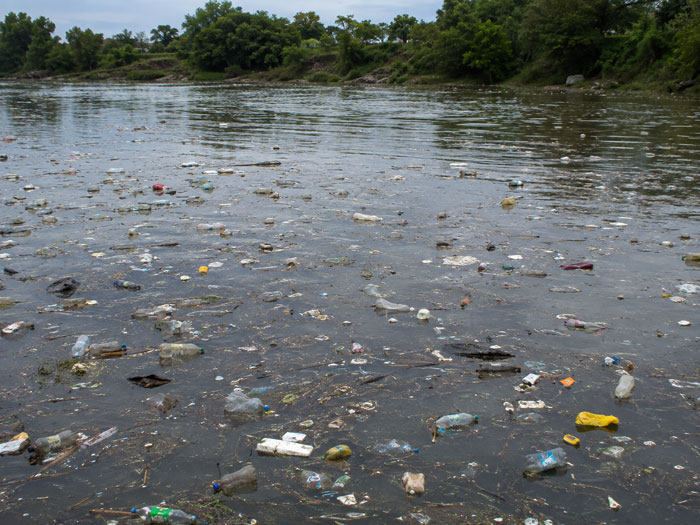
Floating waste has become a common challenge for rivers, canals, ports, reservoirs and other waterways. Plastic bottles, packaging, branches, vegetation and other floating debris can travel long distances with currents, tides and wind before accumulating around waterfront structures or eventually reaching coastal waters.
The problem becomes much more difficult once this debris spreads.
Instead of trying to recover scattered waste across a large water surface, a floating trash boom creates a controlled interception point. It can help intercept, concentrate and guide floating debris toward an area where it can be collected more efficiently.
For ports, municipalities, industrial facilities and waterway operators, a floating trash boom can therefore become an important part of a practical debris management system.
Floating debris rarely stays where it first enters the water.
Rainfall and stormwater runoff can carry plastic waste, vegetation and other materials into drainage channels, canals and rivers. From there, currents can transport the debris downstream toward reservoirs, ports, estuaries and coastal waters.
In ports and industrial waterways, floating waste may accumulate around docks, quay walls, vessel operating areas, intake structures and other waterfront infrastructure. Wind and changing tides can then move the debris again, increasing the affected area.
Once the debris has spread, collection becomes more difficult. Boats, workers or mechanical collection equipment may need to cover a much larger water surface to recover the same amount of material.
This is why floating debris control often starts with a simple idea: intercept the debris before it spreads.
A floating trash boom creates a physical control point where moving debris can be intercepted before it continues downstream or enters a protected area.
A floating trash boom is normally positioned across or along part of a waterway where floating debris is expected to travel.
As debris approaches the barrier, the boom helps prevent it from continuing directly into the protected area. Depending on the installation layout and water movement, it may also guide the material toward a more accessible collection point.
The principle can be summarized as:
Intercept → Concentrate → Guide → Collect
The important point is that a trash boom does not eliminate the need for debris collection. Instead, it makes the collection process more controlled.
Without interception, bottles, packaging, branches and vegetation may become scattered across a large water area. With a properly positioned barrier, more of this material can be concentrated in a predictable location where it can be removed regularly.
For permanent installations, this relationship between interception and collection becomes particularly important. The objective is not simply to stop debris, but to create a manageable process for controlling and removing it.
Rivers and canals are natural transportation routes for floating waste.
Debris entering the water upstream can travel considerable distances before reaching downstream communities, reservoirs, ports or coastal environments. A suitable interception point can help prevent some of this material from continuing through the entire waterway.
This can be particularly useful near urban drainage systems, industrial areas and locations where floating waste repeatedly enters the same section of river.
However, river conditions can vary significantly.
A relatively calm canal carrying plastic bottles and light packaging creates a very different operating environment from a river carrying branches, vegetation and mixed debris after heavy rainfall.
This means the purpose of two trash boom projects may be similar, while the actual operating conditions can be completely different.
For this reason, JXY normally starts by understanding the application and water environment before discussing a preliminary floating trash boom solution.
Ports and harbours face their own floating debris challenges.
Waste can enter a port from nearby rivers, stormwater outlets, urban waterfront areas or tidal movement. Once inside the harbour, floating material can accumulate around quay walls, docks, pontoons, vessels and other operational areas.
Regular cleanup can remove the debris, but continuously searching an entire harbour for scattered floating waste can require considerable labour and equipment.
A strategically positioned floating trash boom can help reduce the area in which debris needs to be managed.
Instead of allowing floating waste to move freely throughout the port, the barrier can intercept or guide it toward a designated area where removal is easier to organize.
For port operators, the objective is therefore not simply to install a floating barrier. It is to create a more controlled approach to managing floating debris within the water area.
Floating debris can be collected using boats, nets, mechanical equipment and other recovery methods. These methods remain necessary, but their efficiency can decrease as the debris becomes more widely dispersed.
A concentrated stream of floating waste entering a river can eventually become hundreds or thousands of individual pieces spread across a much larger area.
Wind, tides and changing currents can make the location of this material increasingly unpredictable.
A floating trash boom changes the nature of the problem.
Instead of trying to find and collect debris everywhere, operators can concentrate more of the material in a controlled area and focus their collection resources there.
This is one of the main reasons trash booms can become useful for long-term floating debris management.
The boom and the collection method should therefore work together rather than being treated as two separate solutions.
Although rivers and ports are common applications, floating trash booms can also be used in canals, reservoirs, lakes, industrial waterfront areas and other locations where floating debris repeatedly creates an operational or environmental problem.
In one project, the objective may be to reduce debris moving downstream. In another, it may be to prevent floating waste from entering a port or industrial water area. Other installations may be designed to guide debris toward a collection point.
This variety of applications also means that one standard trash boom cannot automatically be considered suitable for every site.
The water conditions, debris characteristics, deployment period and site layout can all influence the project requirements.
If you are already evaluating a floating trash boom for a project, our guide 5 Things to Consider Before Buying a Trash Boom explains some of the important factors to review before requesting a quotation.
Two floating trash booms may look similar in a photograph but operate in very different environments.
A sheltered canal carrying mainly light floating plastic presents relatively moderate conditions. A river affected by seasonal rainfall and larger natural debris may place very different demands on the system.
Ports may introduce additional considerations such as tidal movement, changing water levels and continuous operation.
The expected deployment period is also important. A temporary barrier installed for a particular project does not necessarily have the same requirements as a permanent system expected to remain in the water for long periods.
This is why selecting a floating trash boom only according to appearance, dimensions or price per metre may not provide enough information for a project decision.
The application should come first.
As a manufacturer of floating containment and debris control equipment, JXY works with different project conditions rather than treating every waterway as the same application.
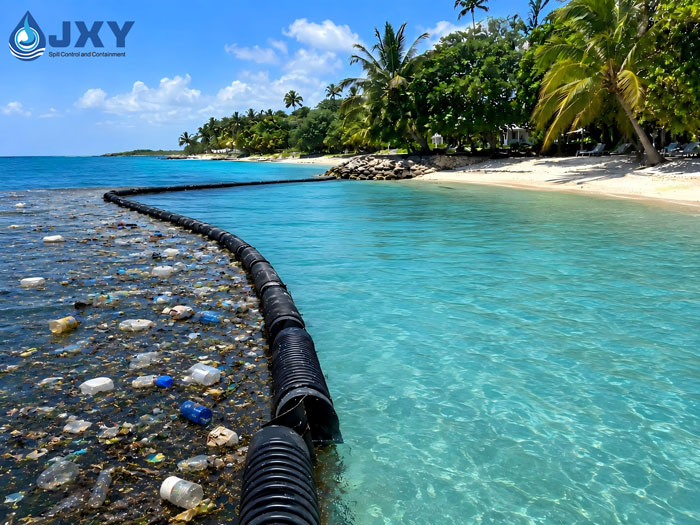
The floating barrier is only one part of an effective debris control project.
Where the boom is positioned affects how the debris approaches and accumulates. The installation arrangement influences how the barrier remains in position. Most importantly, operators still need a practical way to remove the material after it has been intercepted.
In some applications, the boom may be positioned to guide debris toward one side of the waterway rather than allowing it to accumulate evenly across the entire barrier.
For long-term installations, maintenance and access to the collection area also need to be considered.
If debris continues accumulating without regular removal, the loading on the system can increase. A successful installation therefore needs to consider both interception and the practical collection process.
This is why JXY approaches floating trash boom projects as debris control systems rather than simply supplying a specified number of metres of floating barrier.
Customers do not need to determine every technical detail before contacting a manufacturer.
In many cases, a useful project discussion can begin with basic site information.
The project location, approximate required length, typical floating debris and expected deployment period already provide a useful starting point. Site photos and videos can show the width of the waterway, surrounding structures, debris conditions and possible installation areas.
Where available, information about water depth, current velocity, seasonal water-level changes or other operating conditions can help provide a clearer understanding of the application.
Based on this information, JXY can review the project and discuss a preliminary floating trash boom configuration before quotation.
This approach allows the conversation to move beyond simply comparing a price per metre. The more important question becomes whether the proposed system is suitable for the actual application.
JXY manufactures floating trash boom and debris control systems for rivers, canals, ports, reservoirs and other water environments.
Different projects involve different debris conditions, water environments, deployment periods and installation requirements. For this reason, we prefer to understand the application before discussing the final solution.
Our role as a manufacturer is not simply to provide a standard floating barrier. It is to work with the project information provided by the customer and help determine a practical preliminary configuration for the intended application.
This is particularly important for permanent or more demanding installations, where the floating barrier, installation arrangement and debris collection strategy need to work together.
If you are planning a floating debris control project, send JXY your project location, approximate required length and several photos or videos of the site.
Based on the available information, our team can review the application, discuss a preliminary floating trash boom solution and identify any additional information required before quotation.


