

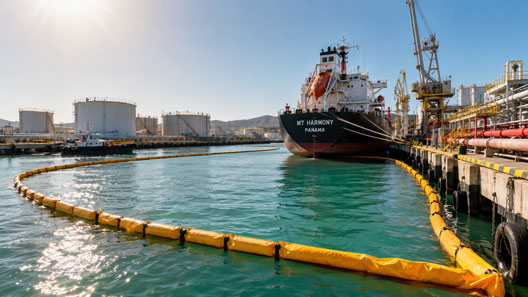
Ports in hot climate regions face special challenges when selecting oil spill response equipment. High temperature, strong sunlight, UV exposure, saltwater, oil contamination, abrasion, and long-term outdoor storage can all affect the performance and service life of an oil boom.
For ports in the Middle East, Africa, Southeast Asia, Latin America, and tropical coastal areas, choosing the right oil boom is not only about size or price. It is about whether the boom can remain reliable in demanding environmental conditions.
A suitable oil boom helps ports control oil spills quickly, protect harbor waters, reduce pollution risks, and support daily emergency response operations. An unsuitable boom may crack, fade, deform, lose buoyancy, or fail during deployment.
Hot climate ports are different from mild climate ports. The equipment may be exposed to high temperatures for long periods, especially when stored outdoors or deployed in open water.
Common environmental challenges include:
Strong UV radiation
High air temperature
Warm seawater
Salt corrosion
Oil and fuel exposure
Abrasion from quay walls and vessels
Long-term outdoor storage
Frequent deployment and recovery
Strong sunlight during emergency response
These conditions can accelerate material aging. If the boom material is not suitable, the fabric may become brittle, the color may fade, the seams may weaken, and the floating body may lose performance.
For this reason, hot climate ports should choose oil booms based on material strength, UV resistance, oil resistance, buoyancy, connectors, storage method, and deployment conditions.
For a complete overview of marine and industrial spill control products, you can also read our main guide here: Oil Spill Response Equipment: Complete Guide for Marine and Industrial Spill Control.
The first factor to consider is the boom material.
In hot climate ports, the oil boom fabric should have good UV resistance, oil resistance, and weather resistance. Common materials include PVC-coated fabric, rubber fabric, and other coated technical fabrics.
PVC oil booms are widely used in sheltered ports, harbors, terminals, marinas, and emergency response applications. They are cost-effective, easy to deploy, and suitable for many port conditions.
Rubber oil booms are usually selected for more demanding environments, longer deployment, stronger oil exposure, and higher durability requirements. Inflatable rubber booms are often used for oil terminals, large ports, and professional oil spill response operations.
When selecting the material, ports should consider:
Expected deployment duration
Whether the boom will be stored outdoors
Oil type and exposure level
Frequency of deployment
Water temperature and air temperature
UV exposure intensity
Required service life
For hot climate regions, it is better to avoid very light-duty materials if the boom will be stored or deployed outdoors for long periods.
Different types of oil booms are suitable for different site conditions. Hot climate does not automatically mean that every port needs the heaviest boom. The right choice depends on water conditions, deployment purpose, and response requirements.
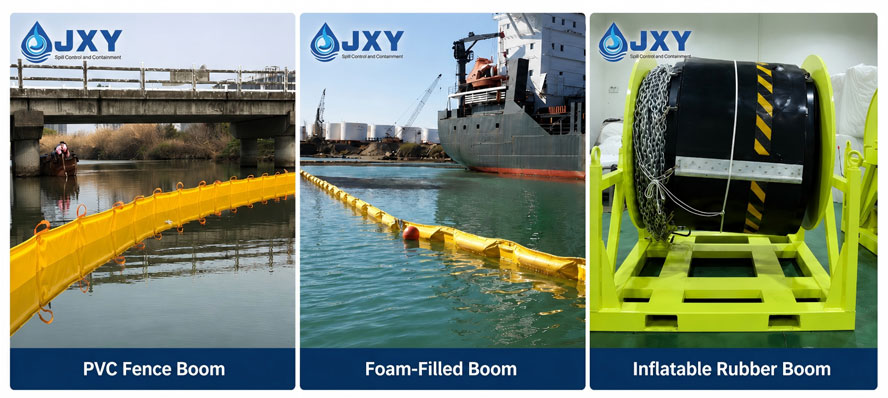
PVC fence boom is commonly used in sheltered port waters, harbors, berths, marinas, and calm water areas. It is suitable for quick deployment and general spill response.
It is a practical option when the port needs an economical oil boom for emergency standby, short-term deployment, or protected water areas.
Foam-filled oil boom has built-in buoyancy and can be ready for deployment without inflation. It is useful for ports that need faster response and simpler operation.
It can be suitable for semi-sheltered waters, terminals, industrial ports, and areas where repeated deployment is required.
Inflatable rubber boom is suitable for professional oil spill response, oil terminals, larger ports, stronger currents, and longer deployment. It usually offers higher durability and compact storage when deflated.
For hot climate ports with demanding emergency response requirements, inflatable rubber boom may be a better long-term option.
The size of an oil boom directly affects its containment performance. For hot climate ports, the boom should be selected based on actual water conditions, not only on budget.
Important size factors include:
Overall boom height
Freeboard above water
Draft below water
Buoyancy size
Skirt depth
Bottom ballast chain
Section length
Freeboard helps prevent oil from splashing or flowing over the boom. Draft helps reduce oil escape under the boom. The bottom ballast chain helps the boom remain stable in the water.
For sheltered harbor waters, a medium-size boom may be enough. For stronger current, vessel traffic, or larger spill risk, a higher boom with stronger tension members and better ballast may be required.
Ports should also consider wave conditions, vessel wake, tidal movement, and current speed before final selection.
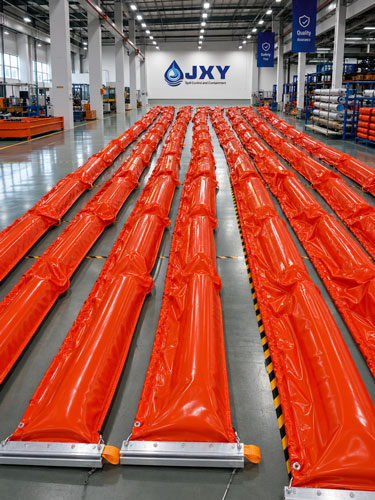
In real port operations, oil booms are not only floating on the water. They also need to withstand pulling force from current, wind, waves, vessel movement, and anchoring points.
For hot climate ports, the tension system and connectors are especially important because material aging and repeated deployment can increase failure risk.
A reliable oil boom should have:
Strong top tension cable
Bottom ballast chain
Reinforced end connectors
Suitable bolts and shackles
Strong towing and anchoring points
Proper section connection design
For long boom systems, the tension load should not be carried only by the boom fabric. The main force should be supported by steel cables, chains, and proper anchoring arrangements.
For ports with strong sunlight and saltwater exposure, stainless steel or hot-dip galvanized components should be selected according to the project requirements and corrosion risk.
Hot climate ports often have strong sunlight, rough quay walls, vessel movement, and frequent boom contact with hard surfaces. This can cause abrasion damage.
Chafe protection is especially important when the boom is used near:
Quay walls
Berths
Vessel sides
Piers
Fuel transfer points
Oil terminals
Sharp concrete edges
Long-term mooring areas
Without chafe protection, the boom fabric may wear quickly at contact points. This can reduce service life and increase maintenance costs.
For long-term deployment, ports should consider additional wear pads, reinforced rubbing areas, stronger fabric layers, or protective sleeves in high-abrasion zones.
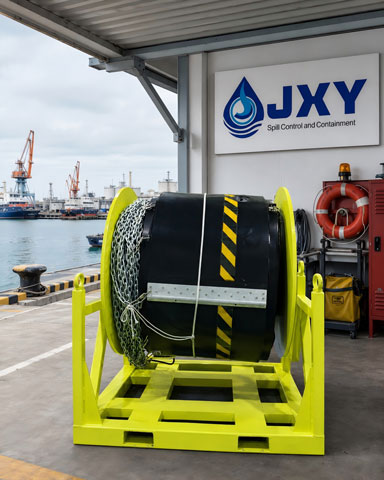
Many oil booms are not deployed all the time. They may be stored in containers, warehouses, boom reels, trailers, or outdoor storage areas.
In hot climate regions, storage condition can strongly affect service life.
Ports should avoid leaving oil booms exposed to direct sunlight for long periods when not in use. If possible, the boom should be stored in a shaded, dry, and ventilated area.
For boom reels or fast deployment containers, ports should check:
Whether the boom is protected from direct UV exposure
Whether the storage area is too hot
Whether the boom is cleaned before storage
Whether metal parts are protected from corrosion
Whether the boom is inspected regularly
Good storage practice can extend the life of the oil boom and keep it ready for emergency use.
The oil boom itself is only one part of the spill response system. Hot climate ports also need proper accessories to ensure safe and effective deployment.
Useful accessories may include:
Boom reel
Towing bridle
Anchor system
Mooring ropes
Shackles
Marker buoys
Solar marine lights
Repair kit
Air blower for inflatable booms
Storage bags or containers
Workboat deployment tools
For ports with night operations, vessel traffic, or long-term deployment, marker buoys and solar lights can improve visibility and safety.
For inflatable rubber booms, the air blower, repair kit, and inflation accessories should be stored together with the boom.
For long boom systems, the anchoring system should be designed according to current, water depth, seabed condition, and deployment layout.
Even a high-quality oil boom needs regular maintenance. In hot climate regions, inspection should be more frequent because UV, heat, salt, and oil exposure can accelerate wear.
Ports should regularly check:
Fabric surface condition
Seam strength
Connector condition
Steel cable and chain corrosion
Buoyancy condition
Abrasion points
Valve condition for inflatable booms
Repair patches and spare parts
Cleanliness after deployment
After use, the boom should be cleaned, dried, inspected, repaired if needed, and stored properly. Contaminated oil or fuel should not be left on the boom surface for long periods.
A simple maintenance plan can help the port keep the boom ready for emergency response and reduce replacement costs.
There is no single oil boom that fits every port. However, the following general selection logic can help:
For sheltered harbor waters and short-term emergency standby, a PVC fence boom can be a practical and economical choice.
For semi-sheltered terminals, frequent deployment, or faster response needs, a foam-filled oil boom may be suitable.
For oil terminals, LNG terminals, large ports, stronger current, long-term deployment, or professional emergency response, an inflatable rubber oil boom or heavy-duty foam boom may be more appropriate.
For quay wall protection, fuel transfer areas, and high-abrasion zones, additional chafe protection should be considered.
For hot climate ports, the final decision should balance cost, durability, response speed, storage method, and site conditions.
Choosing an oil boom for hot climate ports requires more than selecting a standard product from a catalog.
Ports should consider UV resistance, oil resistance, material strength, boom type, freeboard, draft, tension system, connectors, chafe protection, storage method, accessories, and maintenance requirements.
A well-selected oil boom can help ports respond quickly to spills, protect marine environments, reduce operational risks, and meet environmental protection requirements.
JXY can provide PVC fence booms, foam-filled oil booms, inflatable rubber oil booms, boom reels, anchor systems, marker buoys, repair kits, and other spill response accessories for hot climate ports, oil terminals, LNG terminals, and marine engineering projects.
If you are preparing spill response equipment for a hot climate port, JXY can help recommend a suitable oil boom solution based on your site conditions and deployment requirements.


