

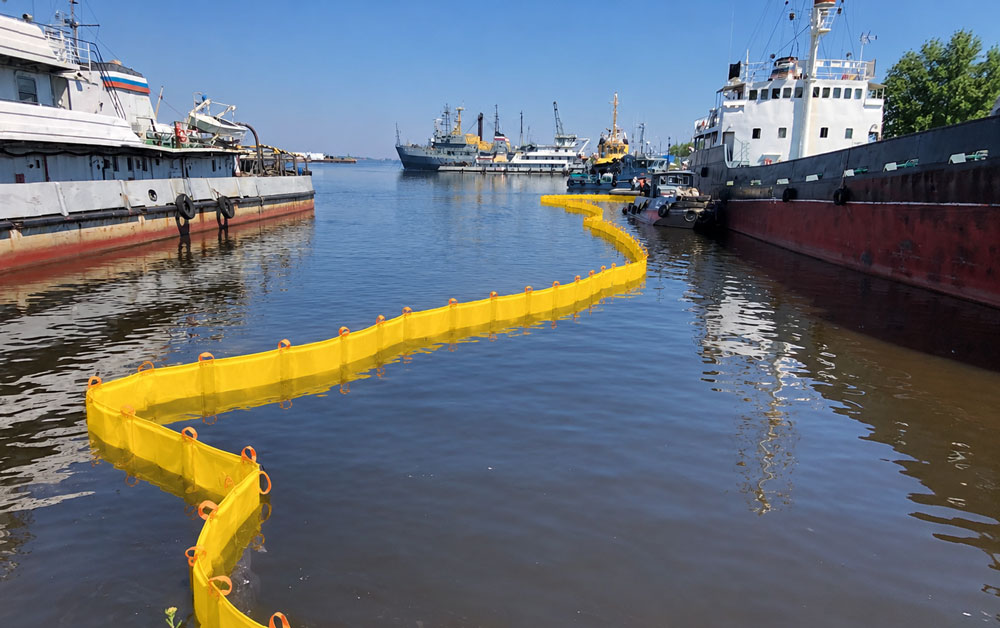
When a port or harbor prepares for an oil spill, the most expensive or technically complex boom is not automatically the best choice.
For many sheltered berths, marinas, terminals and harbor basins, the real purchasing priorities are much more practical. The boom needs to be ready when an incident happens, simple for the response team to deploy, compact enough to store near the waterfront and economical enough that the facility can keep an adequate length on site.
This is where the fence type oil boom has a clear role.
Also known as a fence boom or flat float boom, this type of oil containment boom uses flat foam flotation elements integrated into a vertical boom body. Unlike an inflatable boom, it does not need to be inflated before deployment. Unlike many cylindrical foam-filled booms, its flat construction allows sections to be folded into a relatively compact storage volume.
For ports and harbors operating mainly in sheltered or relatively calm water, these characteristics can make a fence type oil boom a very practical first-response solution.
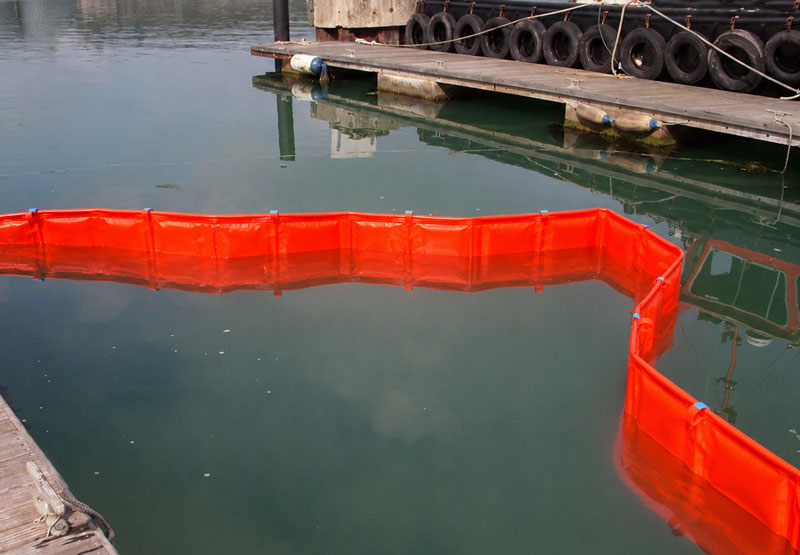
An oil spill does not wait for equipment preparation.
Fuel transfer incidents, leaking vessels, bunkering operations, hydraulic failures and accidental discharges can all release oil into port waters. Once oil begins spreading around berths, pontoons and vessels, containment becomes more difficult.
For this reason, response time matters.
A fence type oil boom has permanent foam buoyancy built into the boom. The response team does not need an air blower or inflation system before placing it in the water. The boom can be removed from its storage area, connected if necessary and deployed directly.
This simplicity is especially attractive for ports that want containment equipment positioned close to fuel berths, loading areas, marinas or other higher-risk locations.
If you are planning a broader port response inventory rather than purchasing only an oil boom, our Port Oil Spill Response Equipment Checklist explains the other equipment and site information that should be considered before requesting a complete quotation.
Storage space is often overlooked during oil boom procurement.
A port may decide that it needs several hundred meters of containment boom, only to discover that the selected boom occupies far more warehouse, container or quay-side space than expected.
Fence boom solves part of this problem through its flat flotation design.
The sections can be folded in an accordion-style arrangement, creating a much smaller storage footprint than many conventional round-float boom designs. This makes it easier to keep substantial lengths of boom inside response containers, storage crates or designated emergency areas close to the deployment point.
That difference becomes even more important when a buyer needs 500 meters, 1,000 meters or more.
Storage efficiency also affects international transportation. A more compact boom can reduce the shipping volume required for a large order, which may make fence boom particularly attractive for overseas ports, distributors and oil spill response organizations building emergency stock.
For buyers comparing different boom constructions, our article Fence Boom vs. Solid Float Boom: Which Oil Containment Solution Is Right for You? explains how storage, buoyancy and operating conditions influence the decision.
The main question should never be simply, “Is a fence boom good?”
The better question is, “Is a fence boom suitable for this water condition?”
Fence type oil booms are particularly useful in relatively calm and sheltered waters. Typical applications can include harbor basins, protected berths, marinas, inland waterways, docks and some fuel transfer areas.
In these conditions, the boom provides a practical combination of flotation, freeboard and underwater draft while remaining relatively light and easy to handle.
This does not mean a fence boom should be selected for every marine environment.
For exposed coastal locations, stronger currents, larger waves or offshore response, a higher-buoyancy inflatable boom, heavy-duty foam boom or rubber containment boom may provide more appropriate performance.
JXY therefore recommends selecting the boom according to the actual water conditions rather than simply choosing the lowest-cost model.
Our Oil Spill Response Equipment section provides a broader overview of containment, recovery, storage and cleanup equipment for different marine and industrial applications.
Although a fence boom has a relatively simple structure, its overall height should not be selected without considering the application.
The portion above the water is the freeboard. It helps reduce oil splash-over and surface escape. The section below the water forms the draft, which helps limit oil from passing underneath the boom.
A larger boom is not automatically better.
Increasing freeboard and draft also changes weight, handling requirements, storage volume and hydrodynamic forces on the boom. The correct balance depends on the port environment and expected spill conditions.
JXY manufactures PVC and PU fence booms in different heights for spill containment applications. Our oil containment boom range includes fence boom configurations with different freeboard and draft dimensions so the equipment can be matched more closely to project requirements.
You can view the broader JXY Oil Containment Boom range for available boom types and configurations.
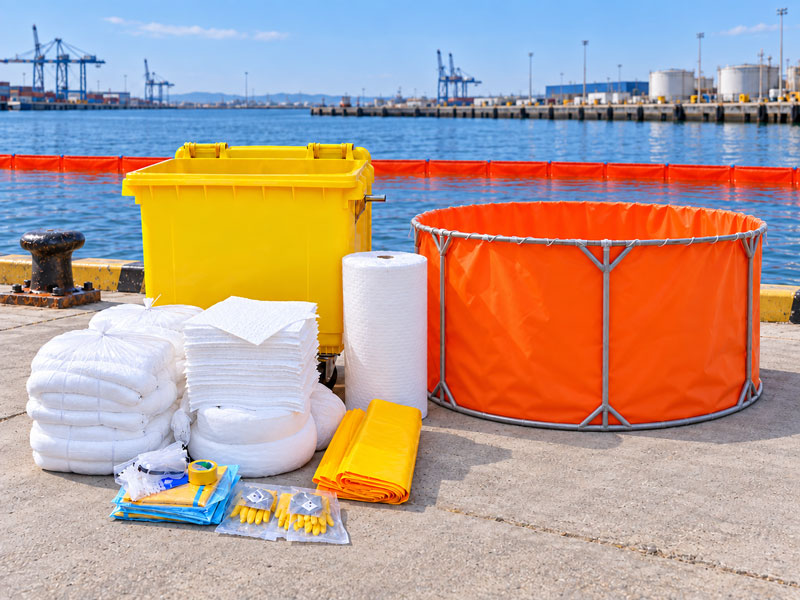
When ports purchase additional boom for an existing inventory, compatibility becomes a major issue.
A new 200-meter boom has limited value if it cannot connect properly to the equipment already stored at the facility.
End connectors allow individual boom sections to be joined into the required deployment length. The connector also needs to maintain the continuity of the boom during use.
For replacement projects and inventory expansion, buyers should tell the supplier what connector system is already being used.
Depending on project requirements, JXY can supply fence booms with different connector arrangements, including configurations intended to match commonly used marine oil boom connection systems.
This is particularly useful for ports and spill response organizations that do not want to replace an entire boom inventory simply because they are purchasing additional sections.
Oil boom quotations frequently specify a total length but pay less attention to individual section length.
In practice, section length affects deployment, transportation, manpower and replacement.
A port purchasing 600 meters of boom does not necessarily want one continuous 600-meter length. Dividing the system into practical sections makes it easier to transport, connect and replace damaged sections.
JXY fence booms can be supplied in practical section lengths according to project requirements.
The most suitable configuration depends on how the boom will be stored, the size of the response team, the deployment method and whether the customer needs flexibility to create different boom lengths for different incidents.
This is why it helps to provide more information than simply writing “500 m oil boom” on an inquiry.
Ports need enough equipment to respond effectively, not simply one premium boom that consumes the entire response budget.
Fence type oil booms can offer an attractive balance between containment capability, purchase cost, storage efficiency and rapid deployment for sheltered water applications.
That makes them useful for facilities that need to stock substantial boom lengths at several response locations.
For example, a port may position different boom packages near bunkering berths, fuel handling areas and harbor response stations instead of keeping all equipment at one central warehouse.
This can reduce the distance between the equipment and the likely spill location.
The objective is not simply to buy the cheapest boom per meter. It is to build a response inventory that the site can realistically store, maintain and deploy.
A professional supplier should also tell you when a product is not the right choice.
Fence booms are particularly practical for sheltered and relatively calm water. If the project involves exposed offshore conditions, significant waves, stronger currents or higher operational demands, another containment boom design may be more suitable.
Inflatable booms provide a different buoyancy-to-weight ratio and are commonly considered for more demanding marine operations. Heavy-duty rubber or foam-filled containment booms may also be appropriate for long-term deployment and harsher environments.
Choosing the correct boom based on site conditions is far more important than trying to use one design everywhere.
This is also why JXY supplies several types of oil containment boom rather than treating fence boom as a universal solution.
A useful quotation starts with useful project information.
Instead of sending only the required number of meters, tell JXY where the boom will be used, whether it is intended for emergency standby or routine deployment, the approximate wave and current conditions, required total length, preferred section length and any existing connector requirements.
If there is already an oil boom specification or tender document, this can also be reviewed before the final model is selected.
These details allow us to determine whether a fence boom is suitable and recommend an appropriate height and configuration.
For projects where conditions exceed the practical range of a fence boom, we can also suggest an alternative containment system rather than supplying equipment that is poorly matched to the site.
Fence type oil booms remain popular because they solve several real problems faced by ports and harbor operators.
They can be stored compactly, deployed without inflation and supplied in substantial lengths without creating the same storage burden as some bulkier boom designs.
For sheltered waters, emergency response stations, marinas, harbor basins and selected fuel transfer areas, that combination can make fence boom an efficient and economical containment option.
But the best oil boom is still the one that matches the actual site.
JXY has manufactured marine oil spill response equipment since 2004 and supplies fence booms, foam-filled booms, inflatable oil booms, rubber containment booms and complete spill response equipment packages for international port, terminal and marine projects.
If you are purchasing a fence type oil boom, send us your required length, deployment location, water conditions, boom height or project specification and connector requirements.
Our team can help confirm whether fence boom is appropriate for the application and provide a technical proposal and quotation based on your project.


