

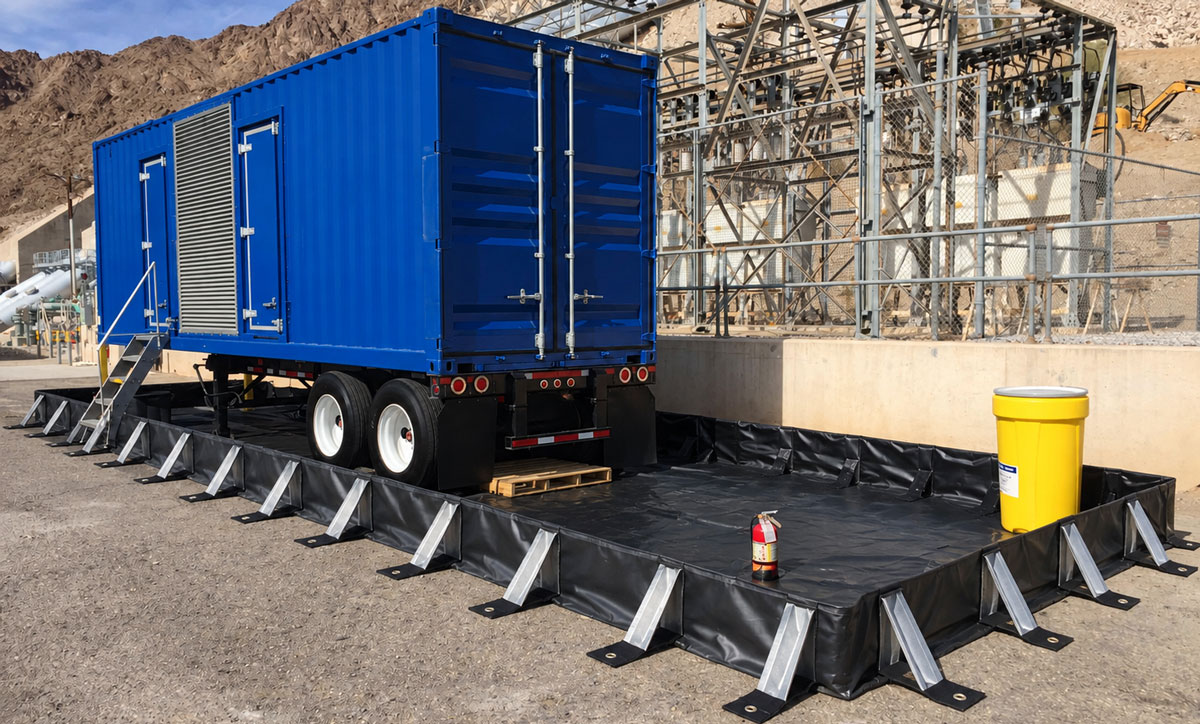
Fuel and oil spills are not limited to major industrial accidents. In many workplaces, they happen during normal daily operations. A fuel tank may develop a small leak, an IBC valve may fail, a hose connection may loosen during transfer, or hydraulic oil may escape during equipment maintenance.
The initial spill may be relatively small. However, if there is no controlled area around the source, fuel or oil can quickly spread across concrete, gravel, soil, or workshop floors. Once this happens, the cleanup becomes more difficult and the risk of contamination increases.
This is why secondary containment is an important part of industrial spill prevention and response planning.
Secondary containment provides an additional barrier around tanks, containers, machinery, vehicles, and other potential spill sources. Its purpose is to keep leaked liquid within a defined area so that operators have more time to recover, absorb, or transfer it before it reaches drains, soil, waterways, or surrounding work areas.
For industrial facilities, construction sites, ports, workshops, mining operations, maintenance zones, and temporary work locations, secondary containment can provide a practical layer of protection before a spill develops into a larger environmental or operational problem.
Secondary containment is a backup containment system positioned around or beneath equipment, storage tanks, containers, or work areas where fuel, oil, or other liquids may be present.
The primary containment is the tank, drum, IBC, machine, vehicle, pump, or other vessel that normally holds the liquid. If this primary system leaks or fails, the secondary containment area helps prevent the liquid from immediately escaping into the surrounding environment.
In simple terms, the primary container stores the liquid during normal operation, while the secondary containment system provides protection if something goes wrong.
Secondary containment does not always mean a permanent concrete bund or fixed structure. Depending on the application, operators may use temporary or portable containment systems, including spill trays, containment areas, or portable spill berms.
Portable systems are particularly useful when equipment needs to move between locations, when maintenance work is temporary, or when containment needs to be deployed quickly as part of an emergency response plan.
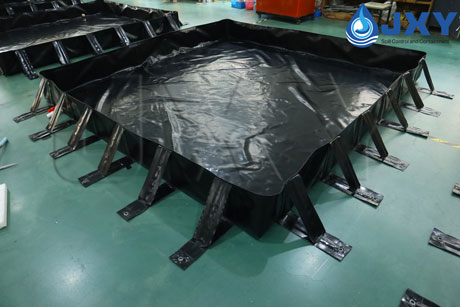 Once fuel or oil begins spreading beyond the immediate source area, spill response becomes more complicated.
The liquid may enter drainage systems, move underneath machinery, contaminate nearby soil, or reach waterways. The affected area becomes larger and the recovery process may require more labor, more absorbent materials, and more waste handling.
Secondary containment helps interrupt this process by keeping the spill close to the source.
A controlled spill is generally easier to recover than one that has already spread across a worksite. By limiting the affected area, secondary containment can help reduce contamination, protect drains and surrounding surfaces, simplify cleanup, reduce operational disruption, and improve overall site preparedness.
The purpose is therefore not simply to clean up a spill more quickly. Effective spill management also means preparing the site so that a leak has less opportunity to become a larger incident in the first place.
Secondary containment is used across many industries because fuel, lubricants, hydraulic oil, and other liquids are handled in a wide range of operating environments.
Fuel tanks and IBC containers are among the most common applications. These containers are widely used at construction sites, industrial facilities, ports, workshops, and remote projects. Leaks may occur from valves, fittings, hoses, accidental damage, or overfilling. A secondary containment area around the tank helps prevent fuel from immediately spreading into the surrounding site.
Oil drums and temporary storage areas can also benefit from secondary containment. Although each individual drum may hold a relatively limited quantity, several drums stored together can represent a significant spill risk. A defined containment area helps keep small leaks under control and makes them easier to identify and manage.
Generators, pumps, and industrial machinery are another common source of fuel and oil leaks. Diesel, lubricating oil, and hydraulic fluid may escape during normal operation, maintenance, servicing, or fluid replacement. Providing containment beneath or around the equipment helps keep these liquids within a manageable area.
Maintenance work is particularly suitable for temporary containment. Servicing machinery often involves opening fluid systems, disconnecting hoses, draining oil, or replacing fuel-related components. In these situations, a portable containment system can be deployed only when the work is taking place and removed afterward.
Fuel transfer areas also require careful planning. During transfer, hoses, valves, and connections are actively handled, which increases the possibility of accidental release. Temporary secondary containment can provide additional protection without requiring permanent construction at every transfer point.
For temporary or mobile applications, a portable spill berm can provide a flexible form of secondary containment.
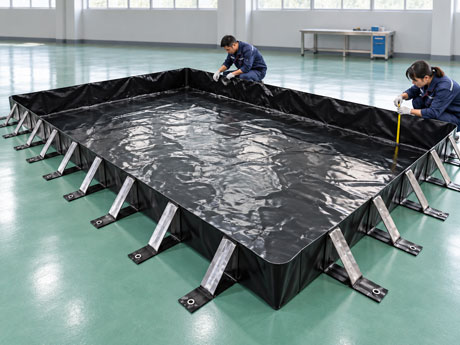
A spill containment berm creates a defined area around tanks, IBC containers, machinery, vehicles, or other potential spill sources. If a leak occurs, the liquid remains within the berm instead of spreading directly across the surrounding ground.
Portable berms are useful for temporary fuel storage, machinery maintenance, vehicle servicing, generator operation, IBC storage, fuel handling, construction projects, remote worksites, and emergency response.
One of the main advantages of a portable spill berm is flexibility. It can be deployed where it is needed, then folded, transported, or stored when the operation is complete. This makes it especially useful for contractors, maintenance teams, ports, industrial facilities, and response organizations that work across multiple locations.
For a more detailed explanation of how spill berms are used around tanks, generators, machinery, and fuel handling areas, you can read our previous article, Why Industrial Sites Need Spill Containment Berms for Fuel and Oil Control.
One of the most common mistakes is to begin with the product instead of the spill risk.
A buyer may ask what size spill berm is needed, but before selecting the product, it is important to understand what actually needs to be contained.
The dimensions of the equipment or storage container are an important starting point. The containment area needs enough usable space for the tank, IBC, machine, vehicle, or other equipment placed inside it. If personnel need to access the equipment during operation or maintenance, additional working space may also be required.
Expected spill volume is another important factor. Some applications are mainly concerned with small operational leaks, while others may need to prepare for a much larger release.
Site conditions also influence the choice of containment. A berm used inside a workshop may face very different conditions from one deployed outdoors on gravel, concrete, or uneven industrial ground.
The frequency of use should also be considered. A containment area that remains permanently beneath a tank may have different requirements from a portable berm that is repeatedly deployed by maintenance or emergency response teams.
Access requirements can also affect the design. Vehicles, machinery, or personnel may need to move into and out of the containment area during normal operations.
Considering the actual application first helps buyers select a containment solution that works in practice rather than simply choosing the nearest standard size.
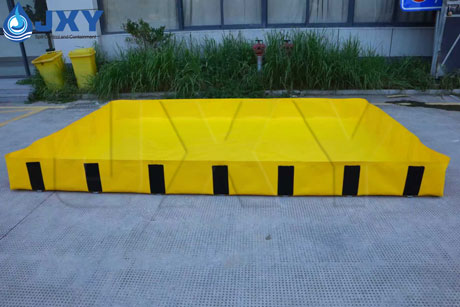 Secondary Containment for Temporary and Mobile Worksites
Temporary worksites can present additional spill-control challenges because the operating environment may change frequently.
Fuel tanks, generators, pumps, vehicles, and heavy machinery may move as a project develops. A permanent bund may not be practical if the equipment itself is not permanently installed.
Portable secondary containment allows the spill-control setup to move with the operation.
This can be useful for construction contractors, marine contractors, mining operations, maintenance crews, and emergency response organizations that regularly work at different locations.
For these users, portability is more than a convenience. It allows containment to become part of the normal operating procedure instead of remaining fixed at one site.
Secondary containment becomes especially important when fuel or machinery is operated close to water.
A relatively small leak on land can become much more difficult to manage if oil reaches a stormwater drain, harbor, river, or coastal environment.
Facilities near water should therefore consider not only the source of a potential spill, but also the path the liquid could take if it escaped.
Secondary containment can provide the first line of defense around the source. If the site also faces a marine spill risk, additional equipment such as oil containment booms, absorbents, pumps, and temporary storage may form part of the wider response plan.
This is why land-based containment and marine oil spill response should be considered as connected elements of overall site preparedness.
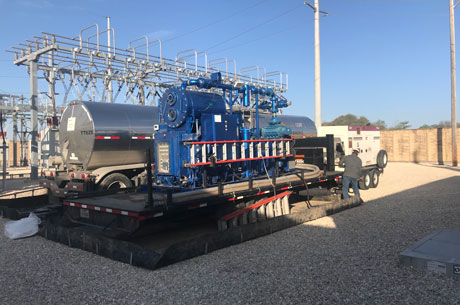 Secondary Containment and Spill Cleanup Equipment
Containing a spill is only one stage of the response process.
Once fuel or oil has been captured inside the containment area, operators still need a practical way to recover and clean the liquid.
In some situations, absorbent pads, rolls, or socks may be enough to collect smaller quantities of oil. In larger spill scenarios, pumps may be required to transfer the collected liquid into temporary storage tanks.
A spill berm can therefore work together with spill kits, oil absorbents, pumps, and temporary storage equipment as part of a broader response system.
This is why many industrial facilities benefit from looking at spill preparedness as a complete process rather than purchasing isolated products without considering how they will work together.
The most effective time to decide how a spill will be contained is before the incident occurs.
Industrial operators can start by identifying locations where fuel and oil are regularly stored, transferred, serviced, or used. These may include fuel storage areas, IBC and drum storage zones, generators, pumps, maintenance areas, vehicle servicing locations, and temporary project sites.
For each location, it is useful to consider what could leak, how much liquid might be released, where the liquid would travel, and what equipment would be required to contain and recover it.
This approach helps turn secondary containment from an emergency purchase into part of normal spill preparedness.
 Choosing the Right Secondary Containment Solution
There is no single containment solution that fits every industrial site.
A small generator may require a very different setup from a large fuel tank, tanker, vehicle maintenance area, or industrial storage zone.
Before requesting a quotation, buyers should provide as much information as possible about the application. This may include the size of the equipment, the type of liquid being contained, the expected containment volume, whether the system will be used indoors or outdoors, the installation surface, the frequency of deployment, and whether vehicles or machinery need to enter the containment area.
The more clearly the operating conditions are understood, the easier it becomes to recommend a practical secondary containment solution.
For applications specifically involving portable berms, our guide Why Industrial Sites Need Spill Containment Berms for Fuel and Oil Control provides additional information about industrial use, sizing considerations, and common applications.
JXY supplies spill containment berms and secondary containment solutions for industrial facilities, maintenance operations, construction projects, ports, temporary storage areas, and emergency spill response.
Containment solutions can be supplied according to equipment dimensions, required containment capacity, operating environment, and intended use.
JXY can also combine secondary containment with other spill response equipment, including oil absorbents, spill kits, pumps, temporary storage tanks, and oil containment booms.
For projects that require a complete spill-control package, different products can be selected according to the site's actual spill risks and response requirements.
Fuel and oil spills often begin as relatively small operational leaks.
What determines the seriousness of the incident is often what happens next.
If the liquid spreads across the ground, enters drainage systems, or reaches surrounding soil and water, cleanup becomes much more difficult.
Secondary containment provides an additional layer of protection by keeping leaked liquid close to the source.
For tanks, IBC containers, generators, machinery, maintenance operations, and temporary worksites, suitable containment can help reduce spill spread and make recovery easier.
Portable spill berms can form an important part of this strategy, particularly where permanent containment is unavailable or where operations frequently move between locations.
Effective spill control starts before the spill happens.
Planning secondary containment around the actual risks of the site can make spill response faster, more controlled, and easier to manage.


