

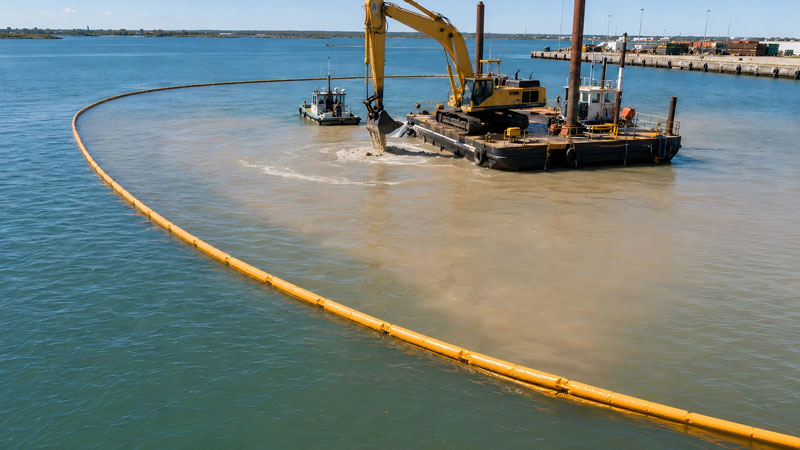
Marine construction activities often disturb soil, sand and fine sediment below the water surface. Once disturbed, these particles may become suspended in the water and move away from the working area with currents, waves or tidal movement.
A silt curtain is a floating barrier used to help contain suspended sediment within a designated area. It normally consists of a flotation section above the water, a flexible fabric skirt below the surface and a ballast chain or other weight along the bottom of the skirt.
Silt curtains are also known as turbidity curtains, sediment curtains or silt barriers in different markets. Although the terminology varies, their main purpose is similar: to reduce the movement of suspended sediment from a marine or freshwater construction site into surrounding waters.
So, where are silt curtains most commonly used?
Dredging is one of the most common applications for silt curtains. During dredging, excavated material may release fine sediment into the surrounding water, particularly when using grab dredgers, cutter suction dredgers or other mechanical equipment.
A floating silt curtain can be installed around the dredging area or along the direction in which sediment is likely to travel. It does not stop the dredging operation or remove sediment from the water. Instead, it helps keep suspended particles within a controlled area, giving them more time to settle.
Silt curtains may be used during maintenance dredging in ports, channel-deepening projects, river restoration and the construction of new navigation channels.
For a more detailed explanation of their role, read how silt curtains control sediment dispersion in dredging projects.
Ports and harbors regularly carry out construction and maintenance activities near the water. These may include berth construction, quay wall repairs, piling, dredging and the expansion of navigation channels.
These activities can disturb sediment close to operational areas and environmentally sensitive waters. Silt curtains can be placed between the construction zone and the surrounding water to help limit the spread of turbidity.
Port projects are rarely identical. Some take place in relatively sheltered basins, while others are affected by waves, tides, vessel movements and changing currents. The curtain size, fabric, flotation system and anchoring arrangement therefore need to be considered according to the actual site.
Land reclamation involves placing sand, rock or other filling materials into coastal waters to create new land. During filling and shoreline construction, fine particles may escape from the reclamation area and increase turbidity in nearby waters.
Silt curtains can be installed along the boundary of the working area to help reduce the uncontrolled movement of suspended material. Depending on the project layout, the curtain may surround a discharge point, separate different construction zones or form a barrier between the work site and a sensitive area.
They are also used in coastal development projects such as marina construction, artificial islands, shoreline reinforcement and waterfront infrastructure.
Because reclamation projects may cover long distances, the curtain is normally supplied in separate sections. These sections can be connected at the job site to form the required total length.
Building or repairing bridges, piers and waterfront structures often requires piling, excavation and concrete work in or beside the water. These activities may disturb the riverbed or seabed and generate localized turbidity.
A silt curtain can be installed around individual working areas, such as bridge foundations or pier construction zones. This helps separate the active work site from the main body of water while allowing construction equipment to continue operating.
For projects with several bridge foundations, the curtain may be moved from one working location to another as construction progresses. In other situations, separate curtain systems can be installed around multiple work zones.
The correct arrangement depends on the width of the waterway, construction method, vessel access and local water conditions.
Underwater pipelines and cables are commonly installed for water supply, drainage, energy, telecommunications and offshore infrastructure. Preparing a trench for the pipeline or cable can disturb bottom sediment and create a visible sediment plume.
Silt curtains may be positioned around a temporary excavation area, shoreline landing point or other section where sediment disturbance is concentrated. They can also be used during backfilling after the pipeline or cable has been placed.
Because pipeline and cable projects usually move along a route, the silt curtain arrangement may need to be repositioned as work advances. Modular curtain sections make transportation, connection and relocation easier.
The project contractor should evaluate whether a floating curtain is suitable for the water depth, current and construction method before deployment.
Silt curtains are not limited to offshore or coastal construction. They are also widely used in rivers, lakes, ponds, reservoirs and canals.
Common inland applications include shoreline repairs, lake dredging, boat-ramp construction, drainage works and environmental restoration. In calm or slow-moving water, a light-duty curtain may provide a practical way to isolate a small construction area.
In rivers or channels, however, flowing water can place additional pressure on the curtain. A suitable curtain and anchoring arrangement must be selected instead of assuming that the same design will work in every location.
For calm-water projects, a Type I light-duty silt curtain may be considered. More demanding port, tidal or exposed projects may require a more robust configuration.
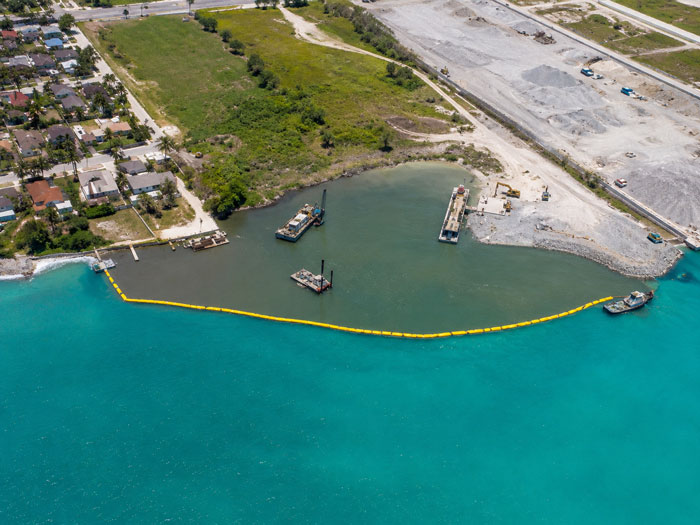
Although silt curtains are used across many types of marine construction, there is no single specification suitable for every project.
A short curtain for a calm pond has very different requirements from a long curtain installed around an active port project. Water depth, current, waves, tidal variation, required deployment length and project duration can all influence the curtain design.
It is also important to understand what a silt curtain can and cannot do. It is designed to help contain suspended sediment and reduce its movement outside the work zone. It is not a water-filtration system, and it cannot compensate for an unsuitable installation or extreme site conditions.
Silt curtains may look similar to other floating marine barriers, but they are designed specifically for sediment control. Read our comparison of silt curtains vs oil containment booms to understand why the two products should not be used interchangeably.
JXY manufactures silt curtains for dredging and marine construction in different sizes and configurations. Curtain depth, section length, fabric, flotation, ballast and connections can be customized according to project requirements.
To request a recommendation or quotation, provide the project application, total required length, water depth and available information about waves, tides and currents.


