

Marine construction projects often take place in complex aquatic environments where water movement, sediment conditions, and environmental requirements can vary significantly.
Whether a project involves dredging, port expansion, bridge construction, coastal protection, or offshore infrastructure, controlling suspended sediment is an important part of responsible marine construction.
A silt curtain, also known as a turbidity curtain, is designed to reduce the movement of suspended sediments outside the working area. However, selecting the correct silt curtain is not simply a matter of choosing a longer or deeper barrier.
The performance of a silt curtain depends on how well the system matches the actual project conditions, including water depth, current speed, sediment characteristics, installation method, and expected construction duration.
A properly designed system helps contractors maintain environmental compliance while reducing the risk of sediment dispersion during marine works.
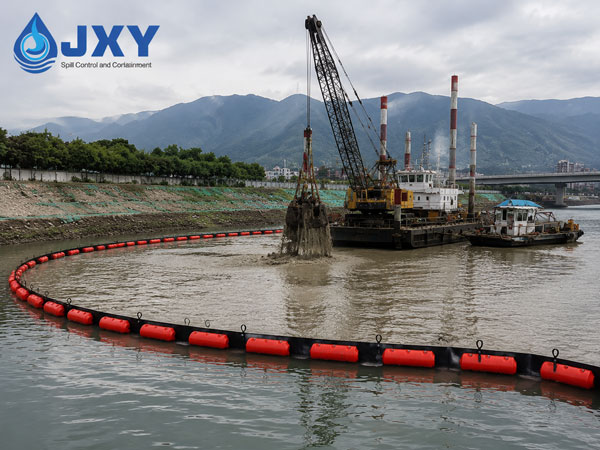 Understanding Silt Curtain Selection
A silt curtain is a complete engineered system rather than only a piece of fabric hanging in the water.
The overall performance depends on the interaction between the floating section, curtain skirt, ballast system, connectors, and anchoring arrangement.
For example, a system designed for a calm lake environment may perform well under low-energy conditions but may experience excessive loading when exposed to tidal currents or vessel-generated waves.
Similarly, a heavy-duty system designed for large dredging operations may be unnecessary for a small protected-water project.
Therefore, the correct selection begins with understanding the site conditions.
Water depth is one of the first factors engineers evaluate when selecting a silt curtain.
The curtain skirt must provide sufficient vertical coverage to control suspended sediments while avoiding unnecessary hydraulic resistance.
In shallow and sheltered waters, a shorter skirt may be suitable because sediment movement is easier to control.
However, deeper marine construction projects often require a carefully designed curtain depth combined with stronger flotation and anchoring systems.
Projects should consider not only the current water depth but also tidal changes, vessel movement, and construction activities that may disturb the seabed.
A correctly selected curtain depth provides effective sediment control without creating excessive forces on the system.
Water movement is one of the most important factors affecting silt curtain performance.
A curtain installed in calm water experiences very different forces compared with a system deployed in tidal channels or open marine environments.
When current flows against the curtain skirt, hydraulic pressure increases. If the system is not designed for these conditions, the curtain may deform, move away from the work area, or experience excessive stress at the connection points.
For this reason, marine contractors should evaluate:
· tidal conditions
· river flow
· wave exposure
· vessel traffic
· seasonal environmental changes
For projects with stronger currents, heavy-duty systems with reinforced components and suitable anchoring arrangements are normally required.
The type of sediment being disturbed during construction also influences silt curtain selection.
Coarse materials such as sand usually settle faster, while fine particles such as clay and suspended silt can remain in the water column for much longer periods.
For projects involving fine sediments, fabric selection becomes especially important.
A permeable geotextile skirt allows controlled water passage while helping retain suspended particles. This design reduces hydraulic loading compared with fully impermeable barriers and is widely used in many open-water marine construction applications.
The correct fabric should be selected according to project requirements, sediment characteristics, and environmental objectives.
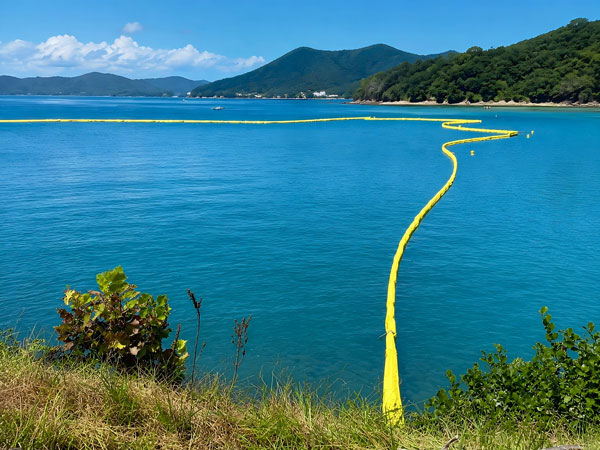
Different marine environments require different levels of protection.
Light-duty silt curtains are commonly used in calm and protected waters where current forces are limited.
Medium-duty systems are suitable for general coastal construction and projects with moderate water movement.
For demanding applications such as major dredging operations, port expansion, and offshore construction, heavy-duty Type III silt curtains are often selected because they are designed to withstand higher environmental loads.
A heavy-duty system typically includes stronger flotation, reinforced fabric, durable connectors, and a properly designed ballast and anchoring system.
The selection should always be based on project conditions rather than using a standard configuration for every application.
There is no single answer because the best choice depends on the project environment.
Permeable silt curtains are widely used in open marine environments because they allow water to pass through the geotextile while reducing suspended sediment movement.
This reduces the pressure created by flowing water and allows the system to perform more effectively under dynamic conditions.
Impermeable curtains may be suitable for specific enclosed applications where preventing water exchange is a priority.
Before selecting between the two options, contractors should consider current conditions, environmental requirements, and the purpose of sediment control.
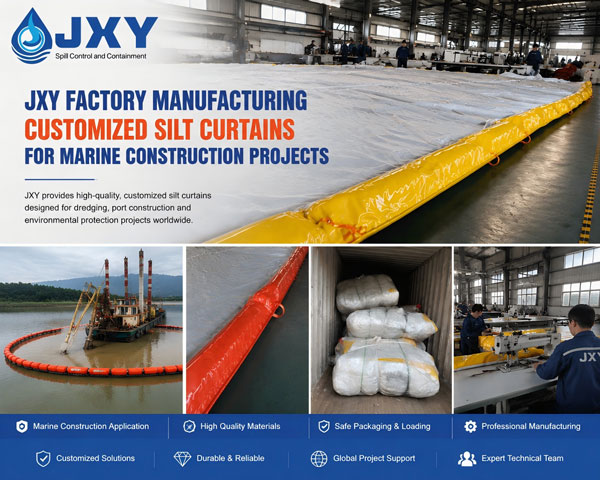 JXY Customized Silt Curtain Solutions
JXY provides customized silt curtain solutions for dredging, port construction, marine infrastructure, and coastal engineering projects.
Based on project conditions, JXY can provide recommendations regarding curtain configuration, fabric selection, float systems, connectors, ballast arrangements, and anchoring solutions.
With manufacturing experience in marine environmental protection equipment, JXY supports contractors, engineering companies, and environmental specialists with project-oriented solutions rather than standard products only.
For more information about common applications of silt curtains in marine construction projects, read:Where Are Silt Curtains Used? Common Applications in Marine Construction.
Every marine construction project has different environmental conditions.
Contact JXY to discuss your project requirements and select the right silt curtain solution.


