

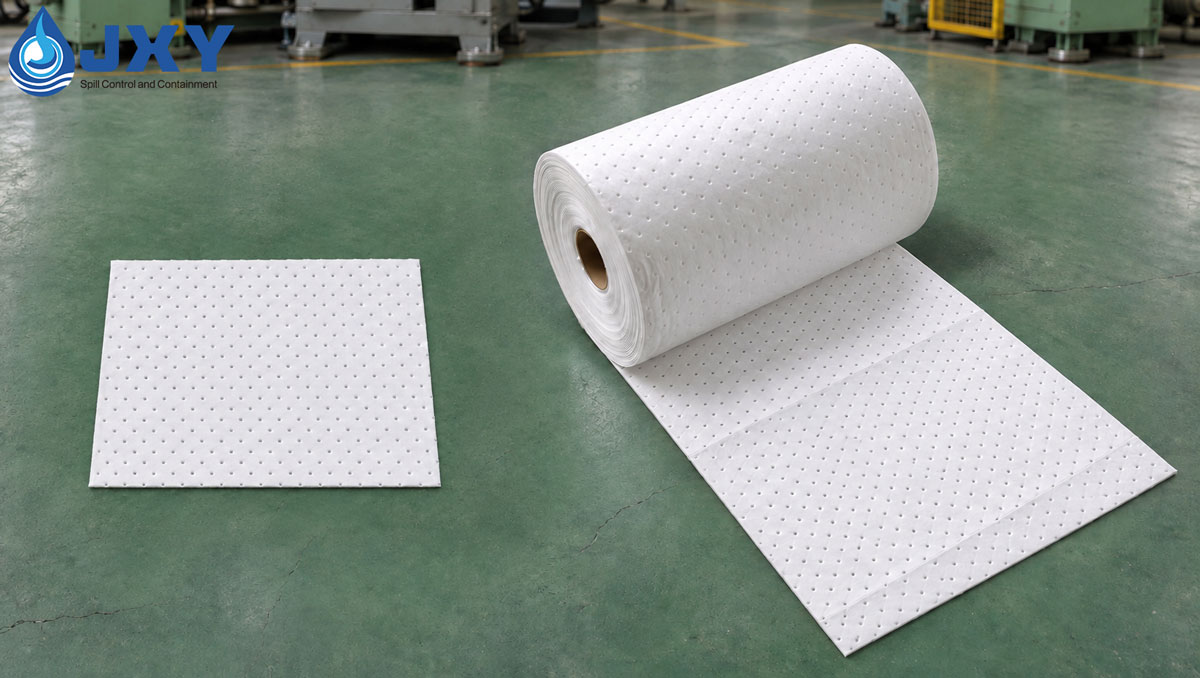
Oil leaks and accidental spills are common challenges in manufacturing facilities, maintenance workshops, shipyards, ports, and petrochemical plants. Having suitable absorbent materials available can improve cleanup efficiency, reduce unnecessary material consumption, and support a safer working environment.
Among the most widely used industrial spill control products are oil absorbent pads and oil absorbent rolls. Although both products can be manufactured from similar polypropylene materials, their formats, applications, and methods of use are different.
So, when should you choose oil absorbent pads, and when are oil absorbent rolls a better solution?
Understanding these differences can help industrial users, distributors, and procurement teams select suitable products and build a more effective spill control system.
Oil absorbent pads are pre-cut sheets designed to absorb oils, fuels, lubricants, and other compatible petroleum-based liquids.
Oil-only absorbent pads are typically manufactured from meltblown polypropylene fibers. Their hydrophobic properties allow them to selectively absorb oil while repelling water, making them suitable for both industrial and marine applications.
Their individual sheet format makes them convenient for localized cleanup, routine maintenance, and immediate spill response.
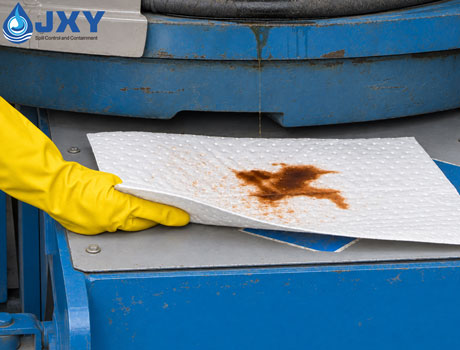 Oil absorbent pads are widely used for:
Hydraulic oil leaks
Machinery and equipment maintenance
Small fuel and lubricant spills
Oil drips around pumps and valves
Automotive repair workshops
Industrial maintenance stations
Oil recovery from water surfaces
Portable spill response kits
For small, localized spills, workers can use individual pads and replace only the saturated material. This helps avoid unnecessary absorbent consumption.
Oil absorbent pads are available in different sizes, thicknesses, basis weights, and surface constructions to meet various industrial requirements.
Explore JXY's Oil Only Meltblown Absorbent Pads for industrial and marine spill cleanup applications.
Oil absorbent rolls are continuous lengths of absorbent material that can be cut or torn to the required size.
Compared with individual pads, rolls offer greater flexibility when covering larger working areas, irregular spaces, or locations where recurring oil leakage may occur.
Some absorbent rolls feature perforated lines, allowing users to separate the required amount of material without using cutting tools.
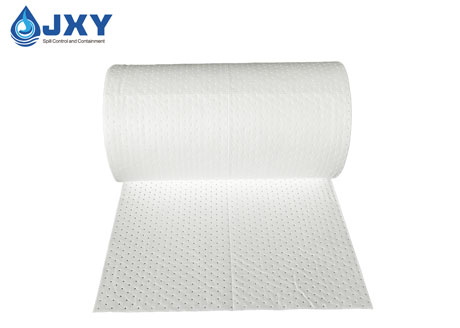 Common Applications of Oil Absorbent Rolls
Oil absorbent rolls are particularly useful for:
Production lines
Large machinery areas
Equipment maintenance zones
Industrial workshops
Pump and hydraulic equipment areas
Fuel handling stations
Shipyards and marine maintenance facilities
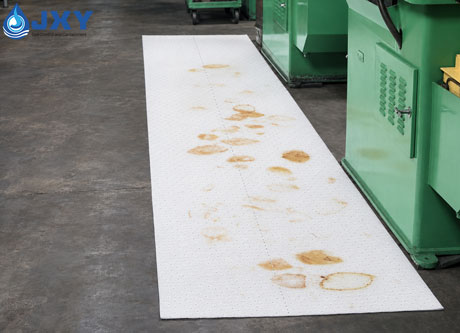
Areas exposed to recurring oil drips
Unlike absorbent pads, which are frequently used for targeted cleanup, rolls can also be positioned in advance beneath equipment where predictable oil drips may occur.
This makes them useful for preventive spill management while maintenance teams address the source of leakage.
JXY offers different roll dimensions and product constructions, including Oil and Fuel Absorbent Rolls and Dimpled Perforated Oil Absorbent Rolls.
Although oil absorbent pads and rolls may use similar raw materials, their main differences are related to product format, coverage flexibility, and application requirements.
Comparison | Oil Absorbent Pads | Oil Absorbent Rolls |
| Product Format | Individual pre-cut sheets | Continuous absorbent material |
| Coverage Area | Small and localized areas | Larger or extended working areas |
| Application Flexibility | Convenient for targeted cleanup | Adjustable to the required length |
| Typical Use | Immediate spill cleanup | Preventive coverage and larger-area cleanup |
| Replacement Method | Replace individual saturated sheets | Replace the used section |
| Storage | Easy to distribute | Suitable for centralized storage and dispensing |
| Industrial Applications | Maintenance, workshops, spill kits | Machinery areas, production lines, recurring leaks |
| Material Efficiency | Suitable for small, isolated spills | Suitable for continuous or extended coverage |
Neither product is universally better than the other.
The most suitable option depends on the spill conditions, working environment, required coverage, and expected frequency of use.
Purchasing decisions are often based on the price per bale or roll. However, the actual cost of spill control depends on more than the initial purchase price.
For small spills, individual absorbent pads allow workers to use only the amount of material required.
For larger areas, absorbent rolls can provide continuous coverage without placing multiple individual sheets.
Selecting the correct format can help reduce unnecessary material consumption.
Pre-cut absorbent pads are convenient when maintenance teams need immediate access to spill cleanup materials.
Rolls can simplify the coverage of extended machinery areas or recurring leakage zones.
The appropriate format depends on how absorbent materials are distributed, deployed, and replaced within the facility.
 Absorption Performance
Absorption capacity is influenced by several factors:
Material composition
Basis weight (GSM)
Fiber structure
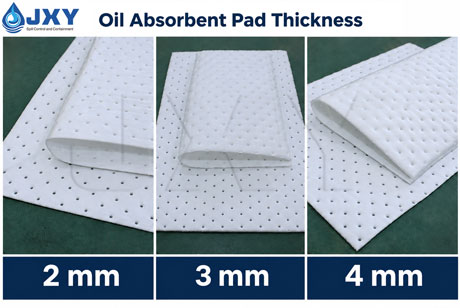
Product thickness
Surface bonding and construction
Type and viscosity of the oil
Absorption and retention characteristics
A heavier absorbent product may offer greater absorption capacity per unit area, but higher basis weight alone does not guarantee better performance.
Procurement teams should compare products using consistent test conditions and confirmed absorption data.
Used absorbent materials must be collected, handled, and disposed of according to applicable local requirements and the characteristics of the absorbed liquid.
Using more absorbent material than necessary may increase contaminated waste volumes and disposal costs.
The most cost-effective absorbent is therefore not necessarily the product with the lowest purchase price. It is the product that delivers suitable performance with efficient material usage, handling, and disposal.
Basis weight, commonly expressed in grams per square meter (GSM), is an important specification when comparing industrial absorbents.
However, GSM should be considered together with product construction and verified absorption performance.
 Light-Duty Absorbents
Light-duty absorbents are generally suitable for:
Routine equipment maintenance
Small oil drips
Light contamination
Applications requiring frequent replacement
They may provide an economical solution when only a limited amount of liquid needs to be absorbed.
Medium-duty absorbents offer a practical option for general industrial applications, including machinery maintenance, workshops, and routine spill cleanup.
They can provide a balance between handling characteristics, material consumption, and absorption requirements.
Heavy-duty absorbents may be suitable for applications involving:
Higher oil volumes
More demanding industrial environments
Frequent machinery leakage
Greater absorption requirements per unit area
The appropriate product grade should be selected according to actual operating conditions rather than simply choosing the thickest available material.
For bulk purchasing, buyers should request confirmed product specifications, including dimensions, basis weight, packaging quantity, and tested absorption capacity.
Where applicable, absorption test results obtained using recognized methods can support more meaningful product comparisons.
Choosing between absorbent pads and rolls is only part of the selection process. It is equally important to choose the correct absorbent material for the liquid involved.
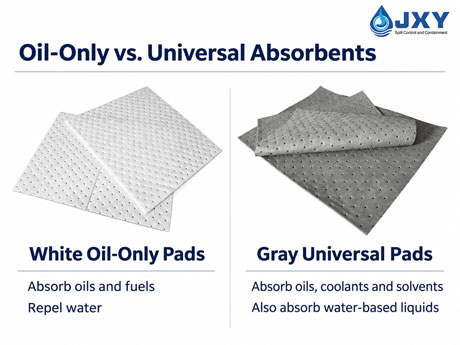
Oil-only absorbents are typically white and are designed to selectively absorb oils, fuels, and compatible petroleum-based liquids while repelling water.
 They are particularly suitable for:
Marine oil spill response
Ports and shipyards
Fuel handling facilities
Outdoor industrial environments
Oil cleanup in wet conditions
Oil recovery from water surfaces
Their oil-selective properties help minimize unnecessary water absorption during suitable cleanup operations.
Universal absorbents are commonly gray and are designed to absorb a broader range of compatible industrial liquids.
Typical applications include:
General industrial maintenance
Machinery workshops
Lubricating oil leaks
Water-based fluids
Coolant spills
Mixed-liquid working environments
Universal absorbents are useful when both oil and water-based liquids may be present.
However, hazardous or aggressive chemicals require a separate compatibility assessment and may require specialized chemical absorbents.
| Feature | Oil-Only Absorbents | Universal Absorbents |
| Typical Color | White | Gray |
| Oil Absorption | Yes | Yes |
| Water Absorption | Designed to repel water | Yes |
| Marine Oil Cleanup | Generally suitable | Generally not preferred |
| General Industrial Maintenance | Oil-related applications | Mixed compatible liquids |
| Main Purpose | Selective oil absorption | General liquid absorption |
Explore JXY's Universal Absorbent Products for general industrial spill control and maintenance applications.
An effective industrial spill control strategy often requires more than absorbent pads or rolls alone.
Different absorbent formats perform different functions. Combining them can help facilities manage both routine leakage and unexpected spills more effectively.
 Industrial Workshops
A practical workshop configuration may include:
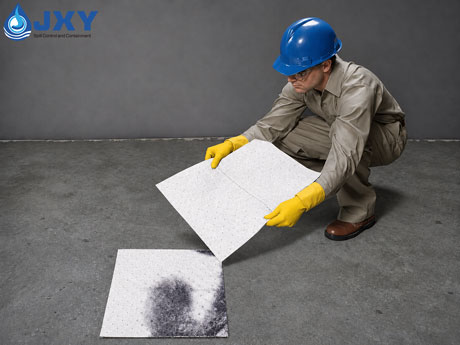
Absorbent pads for localized cleanup
Absorbent rolls beneath equipment with recurring oil drips
Absorbent socks to help limit the spread of smaller spills
Absorbent pillows for concentrated leakage in suitable confined areas
Production facilities may benefit from a combination of absorbent rolls for extended machinery areas and absorbent pads for routine maintenance.
Portable spill kits can also be positioned near higher-risk locations to provide immediate access to spill response materials.
For example, JXY's General Purpose Universal Spill Kit combines multiple absorbent formats to support general industrial spill cleanup.
Oil-only absorbent pads and absorbent booms are commonly included in marine spill response inventories.
For larger marine spills, absorbents should be used as part of a wider response system that may include oil containment booms, oil skimmers, temporary storage tanks, and recovery equipment.
For more information about preparing marine spill response equipment, read our related article:
Port Oil Spill Response Equipment Checklist: What to Include Before Requesting a Quote
Facilities handling fuel and lubricants should consider secondary containment alongside absorbent materials.
Spill containment berms can help restrict liquid from spreading beyond designated storage or handling areas, while absorbent pads, rolls, and socks support smaller spill cleanup and residual oil recovery.
Learn more in our related article:
Why Industrial Sites Need Spill Containment Berms for Fuel and Oil Control
Absorbent products support spill cleanup, but they should not replace leakage source control, equipment maintenance, secondary containment, or professional emergency response procedures.
For industrial procurement teams, distributors, and spill response equipment suppliers, choosing the right absorbent specification is essential for achieving suitable performance and controlling purchasing costs.
Before requesting a quotation, consider the following information:
| Purchasing Factor | Information to Consider |
Liquid Type | Oil, diesel, hydraulic oil, lubricants, or mixed compatible liquids |
| Application Environment | Industrial, marine, outdoor, or indoor |
| Product Format | Pads, rolls, socks, pillows, or booms |
| Dimensions | Required sheet size, roll width, and roll length |
| Basis Weight | GSM or required product grade |
| Absorption Capacity | Required and tested absorption performance |
| Surface Construction | Meltblown, bonded, dimpled, or perforated options |
| Packaging | Quantity per bale, labeling, and packaging requirements |
| Order Quantity | Routine replenishment, bulk purchase, or distribution |
| Customization | Product dimensions, private labeling, and OEM packaging |
Providing these details allows suppliers to recommend appropriate products and prepare more accurate quotations.
Distributors should also consider maintaining a balanced product inventory covering oil-only and universal absorbents, different product formats, and commonly requested industrial specifications.
A well-selected product range can help distributors serve customers across multiple industries without relying on a single absorbent specification.
As a professional oil spill response equipment manufacturer, JXY provides a comprehensive range of absorbent products for industrial, commercial, and marine applications.
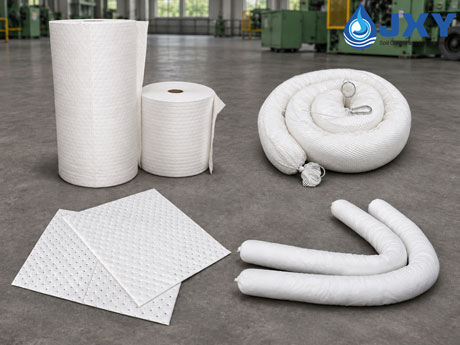 Our absorbent product range includes:
Different product dimensions, basis weights, surface constructions, and packaging options can be selected according to customer requirements.
JXY supports industrial users, international distributors, marine contractors, and oil spill response companies with suitable absorbent products and customized purchasing solutions.
Whether you are purchasing absorbent materials for daily industrial maintenance or developing a complete spill response product range for distribution, JXY can help you select products based on your application and market requirements.
Oil absorbent pads and rolls both play important roles in industrial spill control.
Pads provide a convenient solution for localized spills, equipment maintenance, and immediate cleanup. Rolls offer flexible coverage for larger working areas, recurring oil drips, and preventive spill management.
Rather than choosing one product over the other, industrial users should consider their actual spill risks, liquid types, operating conditions, absorption requirements, and material consumption.
Combining suitable absorbent products can help improve spill preparedness, reduce unnecessary waste, and support more efficient industrial operations.
Whether you are sourcing absorbent materials for daily maintenance, building an industrial spill response inventory, or expanding your distribution product range, JXY can help you identify suitable solutions for your requirements.
Contact JXY for product specifications, bulk quotations, and customized industrial absorbent solutions.


