

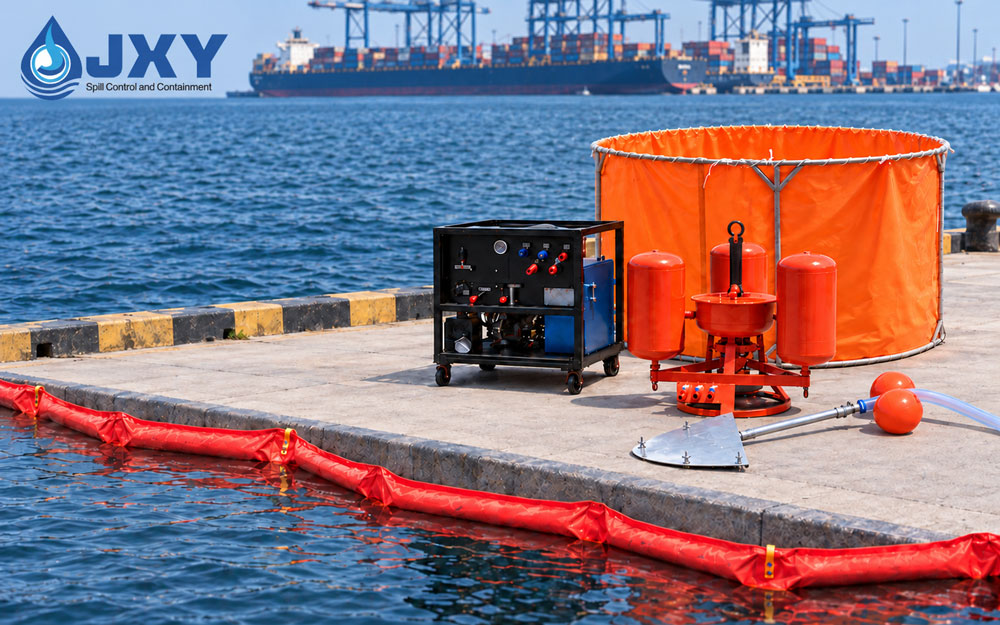
Buying oil spill response equipment should not start with a product list. It should start with one practical question: if a spill happens at your site tomorrow, can your team contain it, recover the oil, store the recovered liquid and complete the cleanup without waiting for missing equipment?
For ports, marine terminals, shipyards, marinas and industrial facilities, this is where many purchasing plans fall short. A site may already own an oil boom, absorbent pads and a pump, but the equipment may not work as one response system. The boom may be too short, the skimmer may not suit the expected oil, the pump may not match the skimmer, or temporary storage may be insufficient.
A better approach is to build the package around the actual spill risk and operating conditions. At JXY, we look at oil spill response as a connected process: contain, recover, transfer, store and clean up.
For buyers who want a broader overview of the complete response process, our Oil Spill Response Equipment: Complete Guide for Marine and Industrial Spill Control explains how containment, recovery, absorbents and temporary storage work together.
The equipment required for a small industrial workshop is very different from what is needed at a fuel terminal or commercial port.
An industrial facility handling lubricants may mainly require absorbents, spill kits and secondary containment around high-risk areas. A waterfront fuel terminal may need containment booms, skimmers, pumps, temporary storage and a much larger absorbent inventory. A port handling tankers or bunker operations may also require equipment that can be rapidly deployed from the quay and remain stable under changing tides, waves and currents.
The expected product matters too. Light fuels can spread quickly and require rapid containment. Heavier oils may require a different recovery method and a pump capable of transferring more viscous liquids.
Instead of buying only by quantity, define the likely spill scenario, oil type, water conditions, deployment method and response time. These details make it much easier to choose equipment that will actually work together.
If you are preparing specifications before approaching suppliers, our Port Oil Spill Response Equipment Checklist: What to Include Before Requesting a Quote provides a practical overview of the project information buyers should prepare.
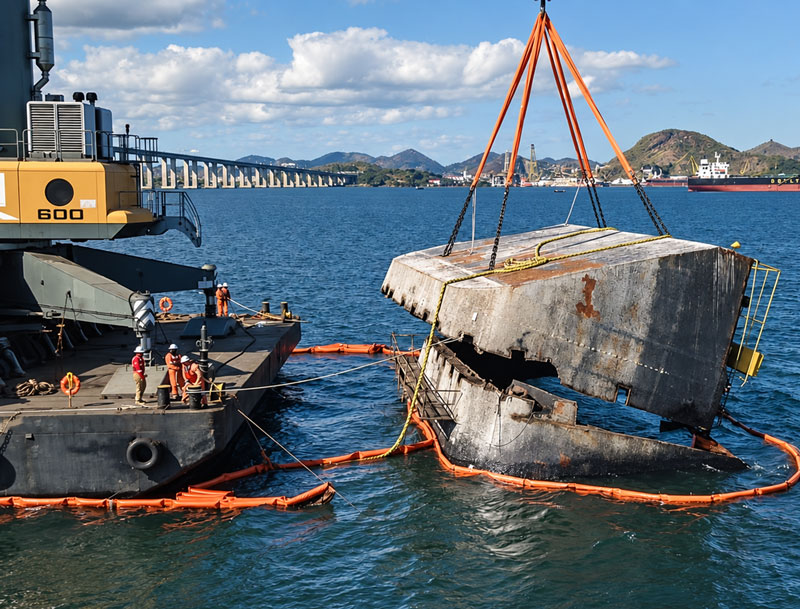
For marine and waterfront sites, an oil containment boom is usually one of the first major elements of the response package. Its job is to limit the spread of oil and create a controlled area for recovery.
Boom selection should be based on the environment. Fence-style and foam-filled booms can be practical for sheltered waters where simple, fast deployment is important. Inflatable rubber booms may be considered where compact storage, larger operational dimensions or more demanding marine conditions are involved.
Freeboard, draft, buoyancy, tension members, connectors and ballast all affect performance. Current and wave conditions are especially important. A boom suitable for a calm marina may not be the right choice for an exposed terminal or marine response operation.
Quantity also requires careful calculation. The required length is not always the straight-line distance between two points. A boom may need to surround a vessel, form a recovery configuration, protect an intake or provide secondary containment.
This is why JXY normally recommends reviewing the application and operating conditions before finalizing boom dimensions and quantity rather than simply selecting a standard model from a catalogue.
Containing oil is only the first step. Once the slick is controlled, the oil still needs to be removed from the water.
Disc, drum, brush, weir and other skimmer designs perform differently depending on oil viscosity, slick thickness, debris level and operating conditions. A common purchasing mistake is to focus only on maximum flow rate.
In practice, recovery efficiency can be just as important. A unit that collects excessive water may quickly fill the available storage capacity without recovering as much oil as expected.
The skimmer should therefore be selected together with its pump, power source and hoses. If one component is undersized or unsuitable, practical system performance may be far below the nominal capacity of the skimmer.
For a port, oil terminal or emergency response station, JXY can configure the skimmer and transfer equipment as one recovery package instead of treating them as unrelated products.
 Pumps are sometimes treated as accessories, but they are essential to a functional oil recovery system.
The pump must transfer the oil or oil-water mixture collected by the skimmer. Viscosity, solids, suction capability, hose diameter, transfer distance and power source can all influence the correct selection.
The recovered liquid also needs somewhere to go.
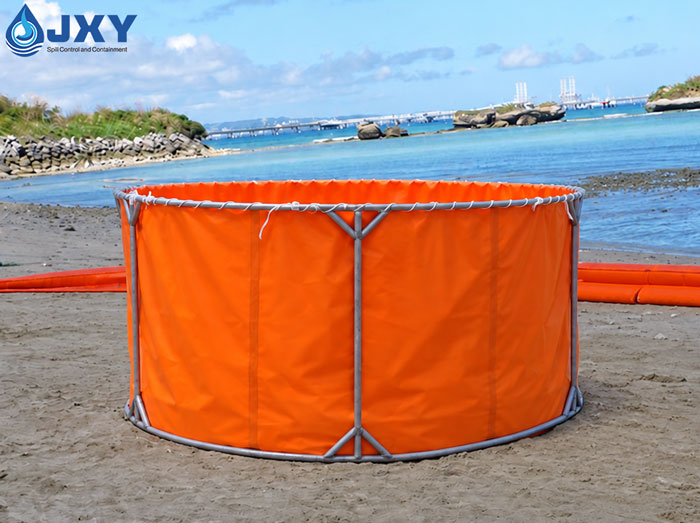
Temporary storage is one of the most frequently overlooked parts of an oil spill response package. If the storage tank becomes full, recovery may have to stop even while oil remains inside the containment area.
Portable tanks, collapsible storage tanks and other temporary liquid storage systems can provide emergency capacity before recovered material is transferred for further treatment or disposal.
Skimmer capacity, pump capacity and temporary storage volume should therefore be reviewed together. Buying a high-capacity skimmer without sufficient transfer or storage capability does not automatically create a high-capacity response system.
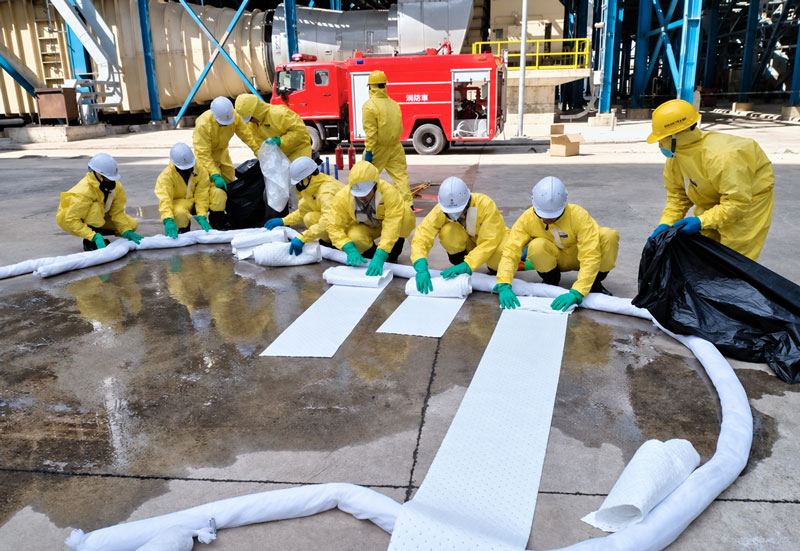 Mechanical recovery equipment will not remove every trace of oil. Absorbent pads, rolls, socks, booms and pillows are still required for final cleanup, small leaks, machinery areas, decks and locations where mechanical recovery is impractical.
Oil-only absorbents are particularly useful in wet and marine environments because they are designed to absorb hydrocarbons while limiting unnecessary water absorption.
Spill kits improve response speed by placing commonly needed cleanup materials in one accessible location. A workshop may need a compact spill kit, while a fuel-handling zone, terminal or industrial facility may require larger mobile units with greater absorbency.
Placement matters as much as capacity. Several correctly positioned spill kits near high-risk areas can provide faster first response than one large kit stored far away.
For specialized port operations, equipment requirements may go beyond conventional oil terminals. Our article Spill Response Equipment for LNG Bunkering Ports explains why diesel, hydraulic oil, lubricants and supporting port equipment still create hydrocarbon spill risks even at LNG facilities.
Not every oil spill starts directly on the water.
Fuel tanks, drums, IBCs, generators, hydraulic equipment and temporary refueling areas can release liquids on land before they reach drains, soil or nearby waterways.
For sites with significant land-based risks, secondary containment can be an important part of the overall response strategy. Portable spill containment berms can be positioned beneath tanks, vehicles, machinery or temporary storage areas to help control leaked liquids before they spread.
This is especially relevant for marine construction and temporary project sites, where fuel storage and heavy equipment may be located very close to the waterfront.
Marine contractors preparing for dredging, piling, quay construction or port expansion can also refer to our article Why Port Contractors Need Spill Response Equipment Before Construction for more project-specific guidance.
A complete response system can still fail because of a missing connector, hose, rope or fitting.
Containment boom systems may require towing bridles, anchor lines, buoys, chains, shackles, repair materials, air blowers or storage reels. Skimmer packages may require hoses, couplings, pumps and power packs. Temporary storage tanks may require suitable fittings and transfer connections.
These items may not be the most visible part of a quotation, but they directly affect how quickly the equipment can be deployed and operated.
When comparing suppliers, buyers should therefore look beyond the main equipment price and confirm exactly what is included in the operational package.
The most effective oil spill response equipment package is one in which every component supports the next stage.
The boom contains the spill. The skimmer recovers the oil. The pump transfers the recovered liquid. The temporary tank stores it. Absorbents handle residual contamination, while spill kits provide immediate response to smaller incidents.
This is why the lowest-priced quotation is not always the lowest-cost solution. Two suppliers may quote similar product names but provide very different levels of operational readiness.
For ports, marine terminals, industrial plants, shipyards and spill response contractors, JXY can help configure a package around actual site conditions, target spill scenarios and required response capacity.
If you are preparing a tender, upgrading an existing response inventory or establishing a new oil spill response station, send us your site information, expected spill risks, water conditions and required response scope.
JXY can help recommend a practical combination of containment, recovery, transfer, temporary storage and cleanup equipment instead of simply quoting individual products.


