

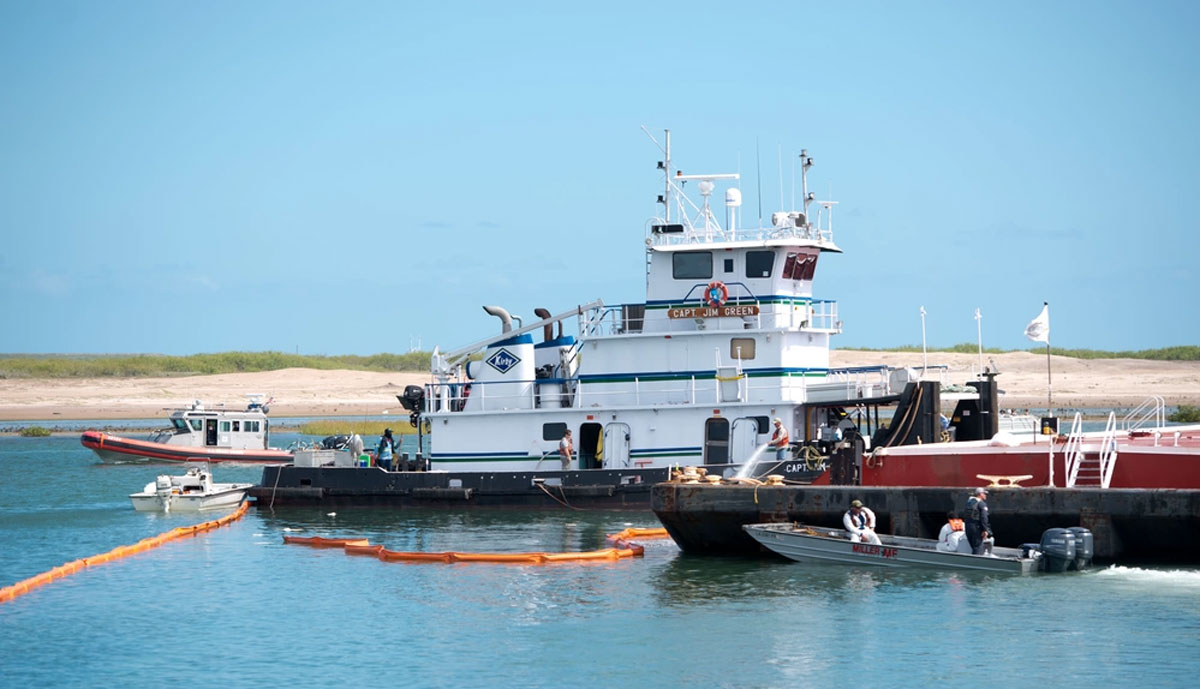
Ship bunkering is an essential part of daily maritime operations. From commercial ports and container terminals to marine fuel stations and offshore support facilities, vessels regularly receive fuel to maintain their operations.
However, transferring marine fuel between vessels, barges, trucks, and shore-based facilities involves environmental risks. A damaged hose, connection failure, tank overflow, or unexpected equipment malfunction can release fuel into the surrounding water.
Even a relatively small oil spill may spread rapidly under the influence of wind, currents, and vessel movement.
This is why oil containment booms for ship bunkering are an important consideration in marine spill preparedness.
When properly selected and deployed, oil booms help restrict floating oil, support recovery operations, and reduce the risk of contamination spreading beyond the immediate transfer area.
For port operators, bunkering companies, and marine contractors, understanding how these barriers work is an important step toward building a practical oil spill response system.
Ship bunkering involves transferring fuel into a vessel's storage tanks through hoses, pipelines, or specialized fuel delivery equipment.
Depending on the port and vessel requirements, fuel may be supplied from shore facilities, tanker trucks, or bunker barges.
During the transfer process, operators must monitor fuel flow, tank levels, hose connections, and communication between the supplying and receiving parties.
Despite established safety procedures, accidental releases remain possible.
A hose connection may leak, a valve may malfunction, or fuel may escape through an overflow point. If the release reaches the water, the oil may spread beyond the immediate bunkering area.
In sheltered harbors, spilled fuel may accumulate near vessel hulls, piers, and waterfront structures. In exposed terminals, wind and tidal movement can transport floating oil toward neighboring berths or sensitive coastal areas.
The environmental consequences depend on the fuel type, volume released, and local conditions.
For these reasons, effective bunkering preparedness should combine preventive operating procedures with suitable oil spill response equipment.
An oil containment boom provides a physical barrier that can help control the movement of floating oil following an accidental release.
However, it should be considered one element of a wider response plan rather than a substitute for safe fuel handling procedures.
Oil containment booms are floating barriers designed to limit the movement of oil across the water's surface.
Unlike absorbent materials, which collect oil through absorption, conventional containment booms primarily restrict or redirect floating oil.
Most designs include a floating section, an underwater skirt, ballast or tension components, and connectors that allow individual sections to form a continuous barrier.
The floating section provides buoyancy and maintains the barrier near the waterline. The portion above the surface, known as freeboard, helps reduce oil passing over the top.
The underwater skirt extends below the surface and helps limit oil movement beneath the boom.
Ballast chains or other tension components help maintain the boom's orientation and distribute operational loads.
During bunkering, these features can help keep floating oil within a manageable recovery area.
However, boom performance depends on current speed, wave conditions, oil characteristics, and deployment configuration. Excessive currents can carry oil beneath the skirt, while strong waves may allow splash-over.
Effective containment therefore requires more than selecting a boom based on total height alone.
The timing of oil boom deployment depends on the applicable port regulations, operational risk assessment, and spill response procedures.
Some bunkering operations may require or benefit from preventive deployment before fuel transfer begins. Other facilities may keep equipment nearby for immediate emergency use.
There is no single deployment arrangement suitable for every port.
Where preventive deployment is required or appropriate, oil booms may be positioned around the vessel, alongside the berth, or around a designated fuel transfer area.
The objective is to establish a containment arrangement before an accidental release occurs.
For example, a sheltered bunkering berth may allow a temporary boom to be positioned around the potential spill area while maintaining safe access for the vessel and operating personnel.
The boom arrangement must remain compatible with mooring lines, fuel transfer equipment, vessel movement, and emergency access.
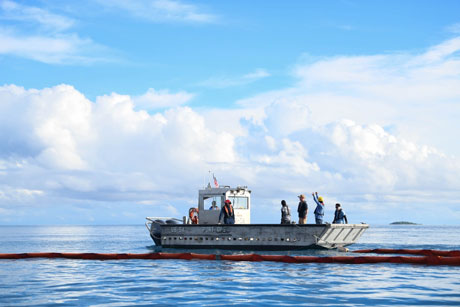 Emergency Deployment Following a Spill
In other situations, oil booms may be stored near the bunkering location for rapid deployment.
If fuel is released, the transfer should be safely stopped and the appropriate emergency procedures activated.
Trained responders can then deploy containment equipment according to the approved response plan.
The effectiveness of this approach depends on equipment accessibility, deployment time, personnel training, and actual water conditions.
For facilities exposed to repeated spill risks, comparing temporary containment with longer-term protective arrangements may be useful.
Our earlier article, Why Permanent Oil Booms Matter for Marine Facilities, explains how permanent and temporary boom systems support different marine protection objectives.
If oil enters the water during a bunkering operation, controlling its movement becomes an important part of the emergency response.
Once the fuel transfer has been stopped safely and the incident assessed, containment booms may help restrict floating oil to an accessible area.
The response team should consider the likely direction of oil movement, available recovery access, and any nearby sensitive infrastructure.
In a sheltered harbor, a boom may help concentrate floating oil near a suitable recovery location.
At a terminal influenced by significant tidal currents, the response strategy may require a different configuration or additional protective measures.
A boom does not remove oil from the water. It creates conditions that may allow recovery equipment to work more effectively.
Depending on the incident, collected oil may be recovered mechanically and transferred to suitable temporary storage.
Oil-only absorbent pads and absorbent booms can also help collect smaller quantities of oil and residual surface contamination.
For more information about combining different response products, see our Oil Spill Response Equipment: Complete Guide for Marine and Industrial Spill Control.
The objective is to coordinate containment, recovery, and cleanup rather than relying on a single product.
Different port environments require different containment solutions.
A small marina with calm water may have different equipment requirements from a large commercial terminal affected by tides, vessel traffic, and stronger currents.
When selecting an oil boom, port operators should consider the expected water conditions, deployment duration, boom dimensions, storage requirements, and handling arrangements.
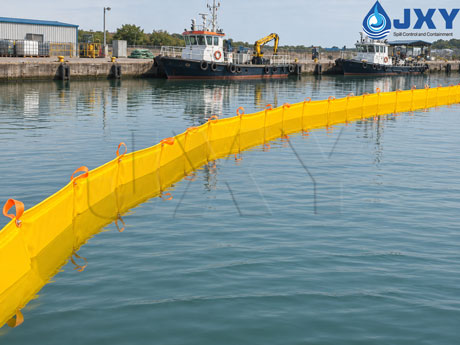
Fence Type Oil Booms use relatively flat flotation components combined with a flexible barrier.
Their compact design can make them practical for storage, transportation, and deployment in suitable sheltered-water applications.
They are frequently considered for harbors, docks, marinas, and other relatively calm marine environments.
For fuel transfer operations in protected port basins, a properly specified fence boom may offer a practical containment solution.
However, flat flotation designs may be less suitable for exposed locations where wave movement is significant.
Our previous article, Why Fence Type Oil Booms Are a Practical Choice for Ports and Harbors, discusses their applications and selection considerations in greater detail.
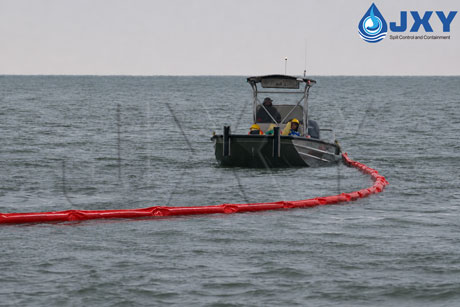 Foam Filled Oil Booms for Marine Spill Response
Foam Filled Cylindrical Oil Booms use buoyant foam flotation elements to maintain their position on the water.
Because they do not require inflation, they can be practical for response situations where straightforward deployment is important.
Depending on their construction, size, and reinforcement, these booms may be suitable for ports, industrial waterfronts, and marine terminals.
They can also be considered for recurring deployment where equipment needs to be reused and handled regularly.
Nevertheless, not every foam-filled boom is suitable for strong currents or exposed marine environments.
The selected product must match the expected operating conditions.
Current speed and wave exposure are among the most important considerations when choosing marine containment equipment.
In strong currents, floating oil may become entrained beneath the skirt even if the boom remains structurally intact.
Wave action may also reduce containment effectiveness by allowing oil to pass over or around the barrier.
Depending on the application, alternative boom designs, angled deployment, or a different containment strategy may be required.
For this reason, buyers should provide accurate site information rather than selecting equipment solely by boom height or price.
 One common purchasing question is how many meters of oil containment boom should be prepared for a particular berth or vessel.There is no universal length suitable for every bunkering operation.
The required length depends on vessel dimensions, berth configuration, potential spill sources, water movement, anchoring points, and the intended containment arrangement.For example, a boom surrounding part of a moored vessel may require a different length from a barrier installed across a designated harbor area.
Additional length may also be necessary to accommodate deployment geometry, safe attachment arrangements, and movement caused by tides.Simply purchasing enough boom to match the vessel's length does not guarantee an effective containment system.
Before preparing a quotation, suppliers should review the intended deployment arrangement and any available site drawings.
This helps ensure that the proposed boom length and accessories are suitable for the actual application.
Oil containment booms are an important component of marine spill preparedness, but they work best as part of a coordinated response system.
A practical bunkering response plan may include containment equipment, oil-only absorbents, recovery devices, suitable temporary storage, deployment accessories, and trained personnel.
Small fuel leaks around equipment may be handled using appropriate absorbent pads, socks, or spill kits.
For larger releases reaching the water, floating containment booms and recovery equipment may be required.
The quantity and type of equipment should reflect the facility's risk assessment and response objectives.
Our article, What Should Be Included in an Oil Spill Response Kit for Ports and Industrial Sites?, explains how different absorbent products and response equipment can be combined for industrial and marine applications.
We have also explored related equipment requirements in Spill Response Equipment for LNG Bunkering Ports.
Although LNG itself is not a conventional floating oil pollutant, associated port operations may still involve diesel, lubricants, hydraulic oil, and other petroleum products that require suitable spill response arrangements.
A complete response strategy should address the actual liquids and operating activities present at the site.
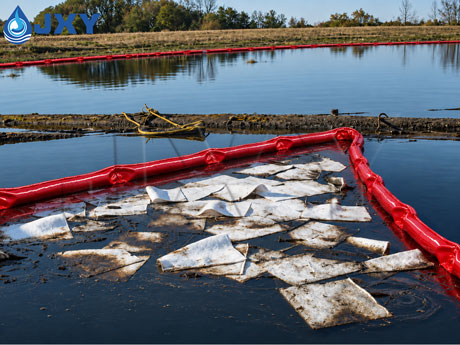 Port facilities vary considerably in layout, environmental conditions, and operating requirements.A containment boom suitable for an enclosed marina may not be appropriate for an exposed industrial jetty.The durability of the boom fabric, flotation design, tensile reinforcement, connectors, and ballast system can all influence its operational performance.
For equipment used repeatedly, ease of handling, storage efficiency, and maintenance requirements also matter.Customization can be useful when projects require particular boom heights, section lengths, connector types, or attachment arrangements.
At JXY, we manufacture oil containment booms for different marine and industrial applications, including Fence Type Oil Booms and Foam Filled Cylindrical Oil Booms.We support customers in selecting suitable boom specifications based on intended applications and available project information.For buyers preparing technical specifications or quotations, sharing site conditions and operational requirements helps establish a more practical equipment proposal.
Ship bunkering is an essential maritime activity, but accidental fuel releases can create environmental and operational challenges.
Oil containment booms provide a practical way to help restrict floating oil and support marine spill recovery.
However, effective protection depends on the right combination of equipment selection, deployment planning, trained personnel, and emergency response procedures.
For port operators, marine terminals, and bunkering service companies, selecting suitable containment equipment before an incident occurs can improve overall spill preparedness.
JXY supplies oil containment booms and related oil spill response equipment for marine and industrial projects worldwide.
Visit JXY Oil Containment Boom Solutions or contact our team to discuss your specifications, project requirements, and customized equipment needs.
JXY — Manufacturing Practical Oil Spill Response Solutions for Marine Operations.


